});

Tuesday, February 12, 2013

Pop-Can Solar Space Heating Collector

Greg's Pop-Can Solar Space Heating Collector

Greg's solar air heating collector uses recycled aluminum soda pop cans for the absorber. The pop cans have the tops and bottoms drilled out, and are assembled into vertical columns that the air passes through. In operation, the black painted soda pop cans are heated by the sun, warming the air that is flowing up through the cans.


A manifold at the bottom evenly distributes room air to all the can columns, and a similar manifold at the top of the collector collects the heated air for distribution back to the room.

The combination of uniform air distribution to the whole collector and the large amount of heat transfer area from the cans to the air makes for an efficient collector. Greg's collector also uses Twinwall polycarbonate glazing -- this is a type of double glazing that reduces heat loss and increases the efficiency of the collector.

Download Greg's detailed 22 page description of how to build this collector... (3 mb pdf)
Thanks very much to Greg for so care fully documenting building the collector, and for making the plans available!


Sources:
http://www.builditsolar.com/Projects/SpaceHeating/GregCanCol/GregCanCo.htm
http://www.knowledgeweighsnothing.com/cheap-to-build-soda-can-solar-space-heating-panels/


Solar Electricity Handbook - 2012 Edition: A Simple Practical Guide to Solar Energy - Designing and Installing Photovoltaic Solar Electric Systems

Solar Energy Dirt Cheap - Harness Solar Power With your Own DIY Solar Panels - Get it Now!

Solar Electricity Handbook - 2013 Edition: A Simple Practical Guide to Solar Energy - Designing and Installing Photovoltaic Solar Electric Systems

Build Your Own Solar Panel: Generate Electricity from the Sun.

Photovoltaics: Design and Installation Manual


Food Storage Without Electricity – Top 10 Foods to Stockpile

Food Storage Without Electricity – Top 10 Foods to Stockpile

Food Storage without Electricity @ Common Sense Homesteading

Food Storage Without Electricity

More than one group of experts are talking about increased risk of soaring food prices and economic instability. With recent droughts and other natural disasters around the world, our food production and delivery system is under a lot of of stress. If you can, I’d highly recommend stocking up on non-perishable food items.
One question that I’ve been seeing a lot in preparedness discussions is how to make real, “living” food a part of your storage plans. Many food storage lists include large amounts of heavily processed food items because they are cheaper, readily available, and have amazing shelf lives.
That’s all well and fine, but you’re supposed to rotate your food storage items regularly by eating out out your storage, and I am not eager to live off of MRE’s, freeze dried meals with hydrolyzed vegetable protein, and commercially canned goods that may contain mold or other questionable ingredients. (We do keep some MREs and freeze dried meals, but they do not make up the bulk of our storage.)
So what are some of the best options for “real food” storage foods? Here are my top ten choices for foods that can be stored at room temperature for extended periods:

1. Lacto-fermented vegetables/ Home Preserved Products

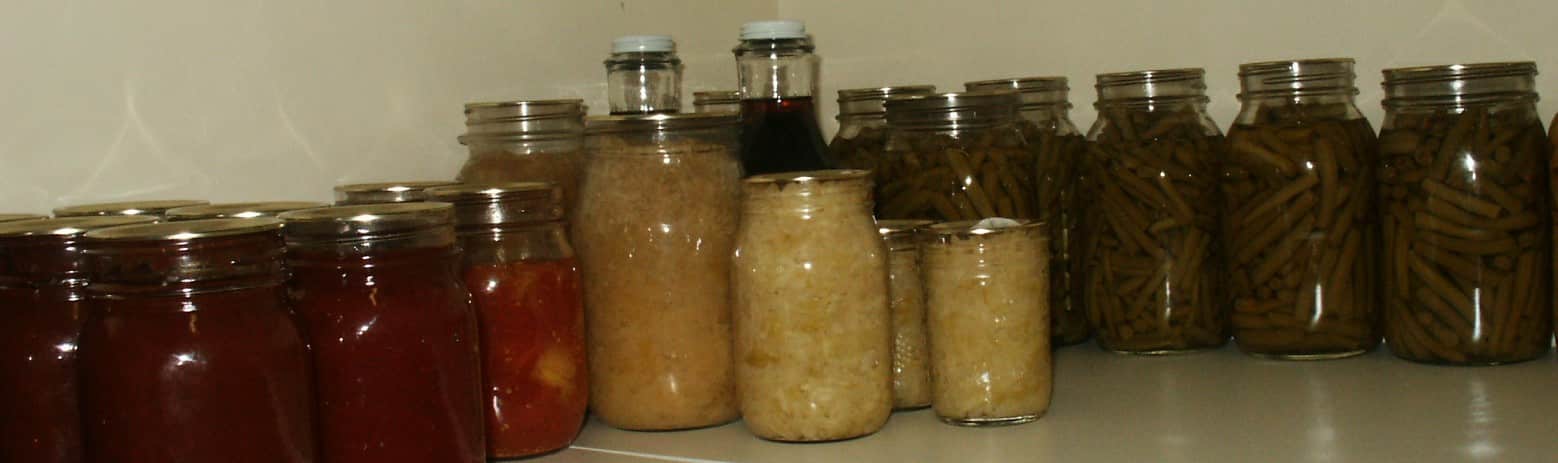
Large containers of properly fermented vegetables can last for months, if not over a year, in cool conditions (for instance, an unheated basement). Captain Cook used kraut on his ships to prevent scurvy, as did other sailors. My husband remembers my mom talking about how they would preserve large crocks (15-20 gallons or more) or kraut from season to season. She said it would sometimes taste a little different but it was still good. In my own experience, this past season I keep two one gallon crocks of kraut in my basement from October until May – seven months – and the quality was still acceptable at that time. The flavor was a little more tangy/bubbly than younger kraut. At this point I repackaged it into smaller containers and put it in the fridge and freezer. Sauerkraut is very high in vitamin C, and is also a good source of vitamin K, which is often deficient in modern diets.
Home canned, dried or root cellared fruits, vegetables and other foods are not quite the nutritional powerhouses that lacto-fermented products are, but they are much easier to use for the bulk of a meal, or for an entire meal. I’ve been working hard this season to preserve the bounty from the garden through canning and and drying, and will soon be filling the root cellar. If you’re unfamiliar with home food preservation, I recommend checking out the post “New to Food Preserving – Start Here“. If you decide to purchase canned food items, make sure to buy from a reputable source.
Food Storage without Electricity @ Common Sense Homesteading

2. Live Culture Dairy

If you keep a yogurt culture that works at room temperature (such as viili from Cultures for Health, which I use), you can use it to culture powdered milk without a yogurt maker. While powdered milk is not ideal, it does store without refrigeration. Culturing makes the nutrients much more digestible. Milk kefir is also an option for a drinkable product. Milk kefir grains can also be used to culture coconut milk, if they are are occasionally revitalized in milk. Kefir provides protein, minerals and B vitamins. Traditional hard cheeses (such as Parmesan) may also last for months in cool dry temps.

3. Whole grains

Whole grains (in general) have excellent shelf lives, much longer than milled flours. Places like Emergency Essentials (listed below) sell grains and grain mills (electric powered and hand powered). If you keep a sourdough culture, you can use it to make many baked goods, not just bread, such as sourdough crackers. Again, using sourdough culturing makes the nutrients in the grain more available. Grains can also be sprouted and used to make a simple essene bread, which is very filling and nutritious. Read about the bulk grain order I organized here.

4. Chia seeds

Chia seeds have a shelf life of 4 to 5 years for dried seeds. They have omega-3 and omega-6 essential fatty acids, fiber, B vitamins, calcium and protein. They can be used to make drinks and no-cook puddings, as well as adding nutrition to baked goods and smoothies.

5. Sprouting seeds

Sprouting seeds also have a great storage life, generally 2 years or more. They are generally high in vitamin C, and may also contain other antioxidants and essential nutrients. They also provide fresh, growing food in a hurry when it may be in short supply. Sprouting seeds are easy to use. You can grow them in handy sprouting kits, or in sprouting bags or even nylon stockings. Mary Bell (in the Dehydrator Cookbook) suggests bringing sprouting seeds with you while camping. She says to soak them overnight in a bag of water, and then place them in a section of nylon sock attached to your backpack. Rinse daily, and in a few days you’ll have live, crunchy additions to your trail rations.

6. High Quality Saturated Fat

Coconut oil, lard and tallow will all keep for at least 12-18 months (most likely longer) in sealed, airtight containers kept in a cool area. Your body needs healthy fats. Your brain is largely made up of fat, as is protective coating on your lungs, and many other critical body systems. Fats are energy dense, which is also critical during emergency situations.

7. Dried Legumes

Dried beans have a great shelf. They will keep around a year in just the plastic bags from the store, 10 to even 30 years if sealed in airtight containers with oxygen removed. Utah State University Cooperative Extension states: “Dry beans average about 22% protein in the seed, the highest protein content of any seed crop. They contain all essential amino acids, except methionine. Methionine can be obtained from corn, rice, or meat. Beans are an excellent source of fiber, starch, minerals and some vitamins. ”

8. Real Salt

Unrefined salt has many trace minerals that are essential to health. In my experience, the unrefined salts (Real Salt, grey sea salt, pink salt, etc.) have a “saltier” more robust flavor, meaning you can use less to achieve the same result. Salt can also be used to preserve food (such as fermenting vegetables, above, and meats). Since ancient times, salt has been also used as a valuable trade commodity.

9. Bulk Spices, Herbs and Teas

Don’t underestimate the power of herbs and spices. As well as being high in antioxidants and anti-inflammatories, many of them have preservative properties as well. The New Agriculturalist explains:
“Cinnamon is just one of a large number of spices that have long been known to preserve food. Recent research has tried to find out exactly how effective the spice can be, over what time period, and in suppressing which bacteria. At Kansas State University, microbiologists have been testing the effectiveness of cinnamon and other spices in eliminating one of the most virulent bacterial causes of food poisoning, E.coli type 0157. Complications arising from the bacteria can include anaemia and kidney problems, and a serious outbreak can lead to fatalities. The Kansas researchers found that cinnamon added to apple juice that had been contaminated with E.coli, was able to kill 99.5% of the bacteria within three days, at room temperature. They also did tests on meat and sausage, and found that cinnamon, cloves and garlic all had a powerful ability to stop the growth of the bacteria. Other microbiologists in Tennessee have found that oils extracted from oregano, coriander and basil, also have strong anti-microbial properties. In future we may see more natural preservatives supplementing the synthetic compounds currently in use.”
I store my spices and herbs in glass jars out of direct light (sometimes using the sock trick). I buy in bulk (generally from Frontier or Mountain Rose Herbs, listed on the sidebar), store a small amount in the cupboard and the rest in the bulk food storage. Both stores sell small, inexpensive glass shaker jars to repackage your spices for easy use. Larger spices, such as cinnamon sticks or other “chunky” spices, can be vacuumed sealed in mason jars to extend shelf life. Under cool, dry conditions out of direct light, spices should have a shelf of two years. They can still be used after this time, but potency will diminish. Spices could also be used as a trade commodity.

10. Sweeteners, Including Refined White Sugar, Raw Sugar, Honey and Maple Syrup

I’m sure some foodies will cringe at the inclusion of white sugar, but it is less expensive than the other options and has a great shelf life (white sugar will last indefinitely if kept in a sealed container in a cool, dry location). It can be used as a preservative for fruits. Sugar can be used to heal wounds (as can honey). (More details on the sugar for wound healing here.) I use sugar to brew my kombucha, too. Raw sugar can store as well as regular sugar, but may be cost prohibitive for many.
Honey can store easily for over a year, possibly decades. They have found edible honey in tombs over 1000 years old. To store honey, Honey.com states:
Processed honey should be stored between 64-75°F (18-24°C).1 Honey can be exposed to higher temperatures for brief periods; however, heat damage is cumulative so heat exposure should be limited. It is best to minimize temperature fluctuations and avoid storing honey near heat sources.
The recommended storage temperature for unprocessed honey is below 50°F (10°C). The ideal temperature for both unprocessed and processed honey is below 32°F (0°C). Cooler temperatures best preserve the aroma, flavor and color of unprocessed honey.
Maple syrup has the shortest shelf life – around one year in glass bottles without freezing or refrigeration.
There are many other food options, but these are my top choices for foods that store a long time without refrigeration. I’ll be covering various food preservation techniques in more detail in the coming months (it’s my thing :-) , including drying, canning, freezing, fermenting, preserving in alcohol and whatever else I can think of trying.

Source:
http://www.commonsensehome.com/preparedness-real-foods-when-you-need-them-most/


Emergency Food Storage & Survival Handbook: Everything You Need to Know to Keep Your Family Safe in a Crisis

The Prepper's Pantry: Building and Thriving with Food Storage

Emergency Preparedness and More A Manual on Food Storage and Survival

Dinner Is In The Jar: Quick and Easy Dinner Mixes in Mason Jars or Mylar Bags (bw)

Friday, February 8, 2013

A solar 'superstorm' is coming and we'll only get 30-minute warning

A solar 'superstorm' is coming and we'll only get 30-minute warning


A solar "superstorm" could knock out Earth's communications satellites, cause dangerous power surges in the national grid and disrupt crucial navigation aids and aircraft avionics, a major report has found.
It is inevitable that an extreme solar storm – caused by the Sun ejecting billions of tonnes of highly-energetic matter travelling at a million miles an hour – will hit the Earth at some time in the near future, but it is impossible to predict more than about 30 minutes before it actually happens, a team of engineers has warned.
Solar superstorms are estimated to occur once every 100 or 200 years, with the last one hitting the Earth in 1859.
Although none has occurred in the space age, we are far more vulnerable now than a century ago because of the ubiquity of modern electronics, they said.
"The general consensus is that a solar superstorm is inevitable, a matter not of 'if' but 'when?'," says a report into extreme space weather by a group of experts at the Royal Academy of Engineering in London.
In the past half century, there have been a number of "near misses" when an explosive "coronal mass ejection" of energetic matter from the Sun has been flung into space, narrowly bypassing the Earth.
In 1989 a relatively minor solar storm knocked out several key electrical transformers in the Canadian national grid, causing major power blackouts.
Similar solar storms significantly increased atmospheric radiation levels in 1956, 1972, 1989 and 2003, the experts found.
Professor Paul Cannon, who chaired the academy's working group on solar storms, said that the Government should set up a space weather board to oversee measures aimed at minimising the impact of solar storms.
"A solar superstorm will be a challenge but not cataclysmic. The two challenges for government are the wide spectrum of technologies affected today and the emergence of unexpected vulnerabilities as technology evolves," he said.
"Our message is, 'Don't panic, but do prepare'. A solar superstorm will happen one day and we need to be ready for it.
"Many steps have already been taken to minimise the impact of solar storms on current technology… We anticipate that the UK can further minimise the impact," he added.
Minor solar storms hit the Earth on a regular basis, but these are far less powerful than the 1859 event named after the British astronomer Richard Carrington, which was the last true solar superstorm.
A similar event today would put severe strain the electricity grid, where transformers are particular vulnerable to power surges, as well as degrading the performance of satellites, GPS navigation, aviation and possibly the mobile phone network, particularly the new 4G network, which relies on GPS satellites for timing information.
"Satellites are certainly in the front line of a superstorm. They are part of our infrastructure and we have concerns about their survival in a solar superstorm," said Keith Ryden, a space engineer at Surrey University.

Source:
http://www.independent.co.uk/news/science/a-solar-superstorm-is-coming-and-well-only-get-30minute-warning-8484058.html


Gerber 31-000751 Bear Grylls Survival Series Ultimate Knife, Serrated Edge

United Cutlery Bush Master Survival Knife

Cold Steel GI Tanto Knife with Secure-Ex Sheath

Gerber 22-01400 LMF II Survival Knife - Coyote Brown


150-Foot Asteroid To Pass Very Close To Earth


150-foot asteroid will buzz Earth, no need to duck

This image provided by NASA/JPL-Caltech shows a simulation of asteroid 2012 DA14 approaching from the south as it passes through the Earth-moon system on Feb. 15, 2013. The 150-foot object will pass within 17,000 miles of the Earth. NASA scientists insist there is absolutely no chance of a collision as it passes. (AP Photo/NASA/JPL-Caltech)


CAPE CANAVERAL, Fla. (AP) — A 150-foot-wide asteroid will come remarkably close to Earth next week, even closer than high-flying communication and weather satellites. It will be the nearest known flyby for an object of this size.
But don't worry. Scientists promise the megarock will be at least 17,100 miles away when it zips past next Friday.
"No Earth impact is possible," Donald Yeomans, manager of NASA's Near-Earth Object program at Jet Propulsion Laboratory in Pasadena, Calif., said Thursday.
Even the chance of an asteroid-satellite run-in is extremely remote, Yeomans and other scientists noted. A few hundred satellites orbit at 22,300 miles, higher than the asteroid's path, although operators are being warned about the incoming object for tracking purposes.
"No one has raised a red flag, nor will they," Yeomans told reporters. "I certainly don't anticipate any problems whatsoever."
Impossible to see with the naked eye, the asteroid is considered small as these things go. By contrast, the one that took out the dinosaurs 65 million years ago was 6 miles wide.
Yet Asteroid 2012 DA14, as it's known for its discovery date, still could pack a wallop.
If it impacted Earth — which it won't, scientists were quick to add Thursday — it would release the energy equivalent of 2.4 million tons of TNT and wipe out 750 square miles. That's what happened in Siberia in 1908, when forest land around the Tunguska River was flattened by a slightly smaller asteroid that exploded about five miles above ground.
The likelihood of something this size striking Earth is once in every 1,200 years. A close, harmless encounter like this is thought to occur every 40 years.
The bulk of the solar system's asteroids are located between the orbits of Mars and Jupiter, and remain stable there for billions of years. Some occasionally pop out, though, into Earth's neighborhood
The closest approach of this one will occur next Friday afternoon, Eastern time, over Indonesia.
There won't be much of a show. The asteroid will zip by at 17,400 mph. That's roughly eight times faster than a bullet from a high-speed rifle.
The asteroid will be invisible to the naked eye and even with binoculars and telescopes will appear as a small point of light. The prime viewing locations will be in Asia, Australia and eastern Europe.
Observers in the U.S. can pretty much forget it. Astronomers using NASA's deep-space antenna in California's Mojave Desert will have to wait eight hours after the closest approach to capture radar images.
Scientists welcome whatever pictures they get. The asteroid offers a unique opportunity to observe something this big and close, and any new knowledge will help if and when another killer asteroid is headed Earth's way.
The close approach also highlights the need to keep track of what's out there, if for no other reason than to protect the planet.
NASA's current count of near-Earth objects: just short of 10,000, the result of a concentrated effort for the past 15 years. That's thought to represent less than 10 percent of the objects out there.
No one has ruled out a serious Earth impact, although the probability is said to be extremely low.
"We don't have all the money in the world to do this kind of work" for tracking and potentially deflecting asteroids, said Lindley Johnson, an executive with the Near-Earth Object observations program in Washington.
Indeed, when asked about NASA's plans to send astronauts to an asteroid in the decades ahead, as outlined a few years ago by President Barack Obama, Johnson said the space agency is looking at a number of options for human explorations.
One of the more immediate steps, planned for 2016, is the launch of a spacecraft to fly to a much bigger asteroid, collect samples and return them to Earth in 2023.
As for Asteroid 2012 DA14 — discovered last year by astronomers in Spain — scientists suspect it's made of silicate rock, but aren't sure. Its shape and precise size also are mysteries.
What they do know with certainty:
"This object's orbit is so well known that there's no chance of a collision," Yeomans repeated during Thursday's news conference.
Its close approach, in fact, will alter its orbit around the sun in such a way as to keep it out of Earth's neighborhood, at least in the foreseeable future, Yeomans said.
Johnson anticipates no "sky is falling thing" related to next week's flyby.
He and other scientists urged journalists to keep the close encounter in perspective.
"Space rocks hit the Earth's atmosphere on a daily basis. Basketball-size objects come in daily. Volkswagen-size objects come in every couple of weeks," Yeomans said.
The grand total of stuff hitting the atmosphere every day? "About 100 tons," according to Yeoman, though most of it arrives harmlessly as sand-sized particles.

Source:
http://news.yahoo.com/150-foot-asteroid-buzz-earth-no-duck-192322385.html


Harmony House Foods Backpacking Kit (18 Count Zip Pouches, Dried Camping Food)

Emergency Survival Food Wise 60 Serving Entree Only One Month Freeze Dried Food Supply

The Dehydrator Bible: Includes over 400 Recipes

Excalibur 3900B 9 Tray Deluxe Dehydrator, Black


How to Make a Solar Still to Purify Water Project

How to Make a Solar Still to Purify Water Project


newskillsforsurvival


Sources:
http://thehomesteadsurvival.com/solar-purify-water-project/

http://newskillsforsurvival.blogspot.com/2012/12/how-to-make-solar-still-make-your-own.html


Mountain House #10 Can Precooked Scrambled Eggs w/Bacon (16 2/3 cup servings)

Mountain House Pro-Pak Freeze-Dried Food (Chicken Teriyaki w/Rice) - Serves 1

Katadyn Vario Multi Flow Water Microfilter

LifeStraw Personal Water Filter


Thursday, February 7, 2013

Mexican Teenagers Killed with Fast and Furious Weapons

Confirmed: Weapons from Fast and Furious were used to gun down teenagers at a birthday party in Mexico in January 2010.


As news breaks that 57 more Fast and Furious weapons have been found in Mexico, it is also being confirmed that some of those weapons were used to slaughter 14 Mexican teenagers and wound 12 more near Ciudad Juarez.
According to reports, a group of armed commandos parked outside a birthday party attended by high school and college students on January 30, 2010, and opened fire with some of the weapons which had been smuggled across the border during the Fast and Furious operation.
The deaths magnify the already gut-wrenching news of Border Patrol Agent Brian Terry's death by a man armed with Fast and Furious weapons in December 2010. The slaughter of the teenagers also draws renewed attention to the hundreds of Mexican citizens who have been confirmed dead by weapons from Fast and Furious over the last two years.
Is this blood on Attorney General Eric Holder's hands?

Source:
http://www.breitbart.com/Big-Government/2012/10/01/Blood-On-Holder-s-Hands-Mexican-Teenagers-Killed-With-Fast-and-Furious-Weapons


Occupy Base


6 Clues Your Ankle is Broken, Not Sprained

6 Clues Your Ankle is Broken, Not Sprained

6 Clues Your Ankle is Broken Not Sprained

by James Hubbard, MD, MPH
Sometimes it’s not that easy to tell a sprain from a broken ankle.
Just this past year, a seventyish-year-old woman came limping into the clinic where I was working to have her ankle checked. Seemed she had twisted it a couple of weeks before and her husband was going to keep nagging her until she came in.
The X-rays revealed a break. A pretty bad one at that. She couldn’t believe it. I don’t know if she was more upset that she was going to need a cast and crutches or she’d have to acknowledge that her husband was right.
Many people come to the clinic convinced they have a break or just as sure it’s just a sprain. Often they end up being wrong. It’s not so easy for doctors to tell either. Fortunately we have the benefit of X-rays. But what if getting an X-ray is impossible? What can tip you off that it’s a sprain or a broken ankle? And why does it matter?

Well, why it matters is easy. If it’s broken, you must be much more careful to stabilize the ankle. Make it so the ankle won’t move. And if it’s any break other than the fibula (the littler of the two leg bones), then you shouldn’t bear a lot of weight on it because, again, the bone fragments could move around, not allowing healing.
The Ottawa Ankle Rules
Years ago, some docs in Canada, trying to cut down on the amount of X-rays done for ankles (Canada must not have as many malpractice suits as we do in the U.S.), came up with a set of guidelines to tell a break from a sprain. It’s called the Ottawa Ankle Rules. The rules aren’t perfect, but many studies since have shown over and over that these guidelines can reliably predict about 95 percent of breaks. They do, however, tend to overdiagnose (predict a fracture that turns out to be a sprain).
The bad news is that studies have also shown that if nonmedical people try to use the guidelines and make predictions they’re not nearly as accurate. So don’t use these to keep from getting your injured ankle checked out when a clinic actually is available. But maybe they can help a little if there ever comes a time when you can’t get expert medical help right away.
Next, the rules.

Source:
http://www.thesurvivaldoctor.com/2013/02/04/sprain-or-broken-ankle/


8 Surprising Anti-Gun Celebrities

8 Surprising Anti-Gun Celebrities
Hollywood’s hypocrisy knows no bounds. While its multi-million dollar movie stars cash in on shoot ‘em up thrillers and cop dramas, they openly move to restrict gun ownership in this country. When the lights turn off and the cameras stop running, these stars put down their prop house guns and pick the Brady Campaign banner. When a fortune is made on the portrayal of guns on the silver and small screen and that cash turns into donations to the anti-gun lobby, it should make every Second Amendment supporter think: Where is my money really going?Fame is a powerful weapon, and it’s hard to believe that these celebs have anti-gun leanings. But they do.
8. - Shania Twain
7. - Kevin Bacon
6. - Matt Damon
5. - Mark Wahlberg
4. - Danny DeVito
3. - Sean Connery
2. - Arnold Schwarzenegger
2 Pack Survival Kit Can Opener, Military, P-51 Model

Survival Wisdom & Know How: Everything You Need to Know to Thrive in the Wilderness

Ready America 70385 Grab `N Go Deluxe 4 Person Backpack

waterBOB Emergency Drinking Water Storage