});
Showing posts with label solar. Show all posts

Sunday, May 15, 2016

DIY Solar Food Dehydrator


I have posted about Solar Dehydrator and ovens before but this is a nice tutorial! Enjoy!

If you like dehydrated food, you would surely like to know how to make it at home. Drying your food can be very useful as it will help you preserve it for a longer period. You can also make lots of delicious and healthy snacks by using this technique, for instance drying all sorts of fruits. So if you want to try this at home, we recommend you to build your own solar dehydrator. Those that run on electricity will cost you a lot, so solar powered ones are a cheap and efficient option. The next tutorial will teach you how to make your own solar powered food dehydrator out of recycled materials. Such a great and useful tutorial!


Materials:
Thin Ply Wood (Body)
4 2.5′ Long 2″ x 4″s
10 feet of 2″ x 2″ wood (Braces and drying shelf support)
A Window (20″ x 23 1/8″) or a suitable slab of clear plastic.
Screen (For covering vents)
Stretchable Cloth/Material. We used stalkings. (For drying rack)
2 Hinges
Screws
Staples
Thermometer
A Hook & String (To fasten the rear door)
Caulk (For perfectionists)

Red more from the source http://www.goodshomedesign.com/diy-solar-food-dehydrator/

Books Of Interest:


Materials:
Thin Ply Wood (Body)
4 2.5′ Long 2″ x 4″s
10 feet of 2″ x 2″ wood (Braces and drying shelf support)
A Window (20″ x 23 1/8″) or a suitable slab of clear plastic.
Screen (For covering vents)
Stretchable Cloth/Material. We used stalkings. (For drying rack)
2 Hinges
Screws
Staples
Thermometer
A Hook & String (To fasten the rear door)
Caulk (For perfectionists)

Source

Books Of Interest:


Thursday, April 14, 2016

DIY Solar Oven

 
A Do-It-Yourself Solar Oven, is a simple, low cost project that anyone can complete in a couple of hours, once you have collected the materials. We'll start with a very simple design, that gives you a working solar oven.

Materials for a Solar Oven

  • Cardboard box, around 20" x 20" x 18", double-walled corrugated cardboard works best.
  • A sturdy piece of cardboard, just slightly larger than the opening of the cardboard box. If the cardboard box is 20" x 20", then make this piece around 21" x 21".
  • Tape. Duct tape works well.
  • 1" thick hardboard insulation - enough to cover the bottom and sides of the box. Not styrofoam.
  • Heavy duty aluminum foil - about 10 square feet.
  • White glue.
  • Flat, black spray paint - used for BBQ or wood stoves works best.
  • A big roasting bag or a piece of glass, slightly larger than the opening of the box.
  • A BBQ thermometer.

Assemble the Solar Oven

  1. Bend the flaps of the cardboard box, OUT and DOWN and tape them down at the corners.
  2. Prepare the insulation & aluminum foil & glue into the box.
    • Cut the insulation to size, to fit the bottom & 4 sides of the inside of the box - if you don't have insulation you could use several pieces of cardboard instead. If you double the pieces of insulation, you get even better results.
    • Glue aluminum foil to one side of each piece of insulation and spray with black paint.
    • Glue the pieces of insulation into the box, with the black sides facing the inside of the oven.
  3. Prepare the Lid
    • cut a piece of cardboard slightly larger than the opening of the oven. Then cut out a hole the same size as the opening of the oven and tape the roasting bag over this hole (single ply only).
    • if using glass, you don't need the cardboard or roasting bag. Just ensure the glass is slightly larger then the oven opening and makes a good seal when placed on the top.
  4. Poke BBQ thermometer through front of oven and seal with tape.

Cooking with your Solar Oven

Aim the oven into the sun by looking at the shadows - don't look at the sun. Periodic repositioning into the sunlight will be required.
Place a drip pan at the bottom of the oven, to catch spills, boil-over's, etc. You need a black pot with a snug lid for cooking. Glass jars, painted black, also work well. Try different pots till you find one that works well. Remember that the pot or jar can get very hot!
This simple oven will work well for warming rolls and keeping cooked items hot. It also works well for items that don't need a set temperature (rice, beans, soup, corn of the cob).

Improving your Solar Oven Design

Materials

You might want to try using plywood rather than cardboard for a longer lasting oven. For sure, you'll want to use a glass window rather than roasting bag. Improve your seal around the glass window and all the joints in the oven to reduce heat loss.

Reflectors

DIY Solar Oven with Reflectors

You can boost the heat quite a bit with reflectors. These can be fairly simple as well - cardboard, with aluminum foil glued to them, and taped together and to the oven. Use the shadows to aim everything towards the sun.

Size

Bigger capacity ovens with larger reflectors are capable of getting really hot. They are also easier to work with: getting food in and out.

Source:
https://web.archive.org/web/20130430193223/http://greenterrafirma.com/diy-solar-oven.html

Friday, April 1, 2016

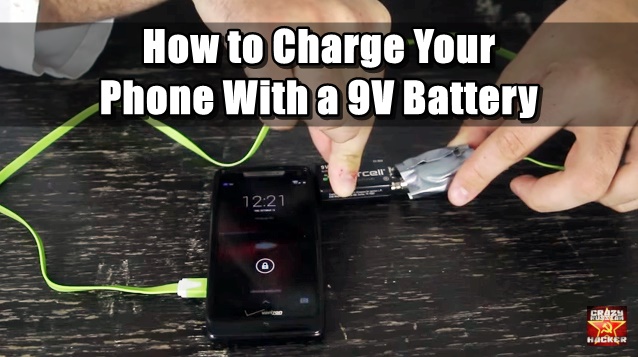
How to Charge Your Phone With a 9V Battery

I feel stupid for not even knowing or seeing this life hack until now. I have many of these batteries just laying around. I haven’t needed a 9v battery in years.
This works well (I just tried it) my new iPhone 6 plus went from 2% to 11% in 16 mins. Not to shabby, huh? I wouldn’t go around charging your phone using this method on a daily basis but in an emergency or a no other choice situation this is a great alternative way to charge your cell phone.
Simply place the end of the car charger into the positive (+) end of the battery, and use a key to bridge the gap between the metal piece on the side and the negative (-) end of the battery. You can hold it in place, or use the tape to hold it all together if you wish.
Plug your cell phone, camera, or whatever else you would want to charge into the car charger, and voila — power.
Check out the video from the crazy Russian hacker below:

Source

Solar Chargers:

Tuesday, February 12, 2013

Pop-Can Solar Space Heating Collector

Greg's Pop-Can Solar Space Heating Collector

Greg's solar air heating collector uses recycled aluminum soda pop cans for the absorber. The pop cans have the tops and bottoms drilled out, and are assembled into vertical columns that the air passes through. In operation, the black painted soda pop cans are heated by the sun, warming the air that is flowing up through the cans.


A manifold at the bottom evenly distributes room air to all the can columns, and a similar manifold at the top of the collector collects the heated air for distribution back to the room.

The combination of uniform air distribution to the whole collector and the large amount of heat transfer area from the cans to the air makes for an efficient collector. Greg's collector also uses Twinwall polycarbonate glazing -- this is a type of double glazing that reduces heat loss and increases the efficiency of the collector.

Download Greg's detailed 22 page description of how to build this collector... (3 mb pdf)
Thanks very much to Greg for so care fully documenting building the collector, and for making the plans available!


Sources:
http://www.builditsolar.com/Projects/SpaceHeating/GregCanCol/GregCanCo.htm
http://www.knowledgeweighsnothing.com/cheap-to-build-soda-can-solar-space-heating-panels/


Solar Electricity Handbook - 2012 Edition: A Simple Practical Guide to Solar Energy - Designing and Installing Photovoltaic Solar Electric Systems

Solar Energy Dirt Cheap - Harness Solar Power With your Own DIY Solar Panels - Get it Now!

Solar Electricity Handbook - 2013 Edition: A Simple Practical Guide to Solar Energy - Designing and Installing Photovoltaic Solar Electric Systems

Build Your Own Solar Panel: Generate Electricity from the Sun.

Photovoltaics: Design and Installation Manual