});
Showing posts with label weapons. Show all posts

Tuesday, June 14, 2016

The AR-15 Is NOT An Assault Rifle


The Orlando terrorist made the AR-15 his weapon of choice to slaughter 49 innocent Americans inside the Pulse nightclub in downtown Orlando, Florida. That act of terrorism has caused media outlets and anti-gun politicians to call the AR-15 the “mass shooter’s weapon of choice” and renewed calls for a ban on assault rifles.


[scroll down for video]
Yet by any definition of the term, the AR-15 is not an assault rifle – it simply is not capable of doing what an assault rifle does.

What defines an assault rifle?

There are many criteria such as the use of detachable magazines (something almost all modern firearms do), and the use of an intermediate cartridge such as the .223 or 5.56 caliber ammunition used by an AR-15.
But the primary difference between an AR-15 style modern sporting rifle and an assault rifle is selective fire – the ability to switch from semi-automatic and fully automatic fire.


The AR-15 rifle is a gas powered, semi-automatic rifles which means that one press of the trigger results in one round being fired. The United States military uses weapons like the M-16 and the M4 that both look like an AR-15 but provide both fully automatic fire and three-round burst fire – both of which are not possible with an AR-15.


Just because they look the same, doesn’t mean they function the same.

The AR-15 looks almost identical to the M16 and M4 carbine assault rifles for a very simple reason. It’s an almost ideal rifle with exceptional ergonomics and design — almost like the military spent millions of dollars and decades working on the design and refining it to be a very high quality rifle. Oh wait, they did.
Beyond the ergonomics and functionality, what draws people to the AR-15 is that it is heavily customizable like it’s similar looking but very differently functioning military cousins.
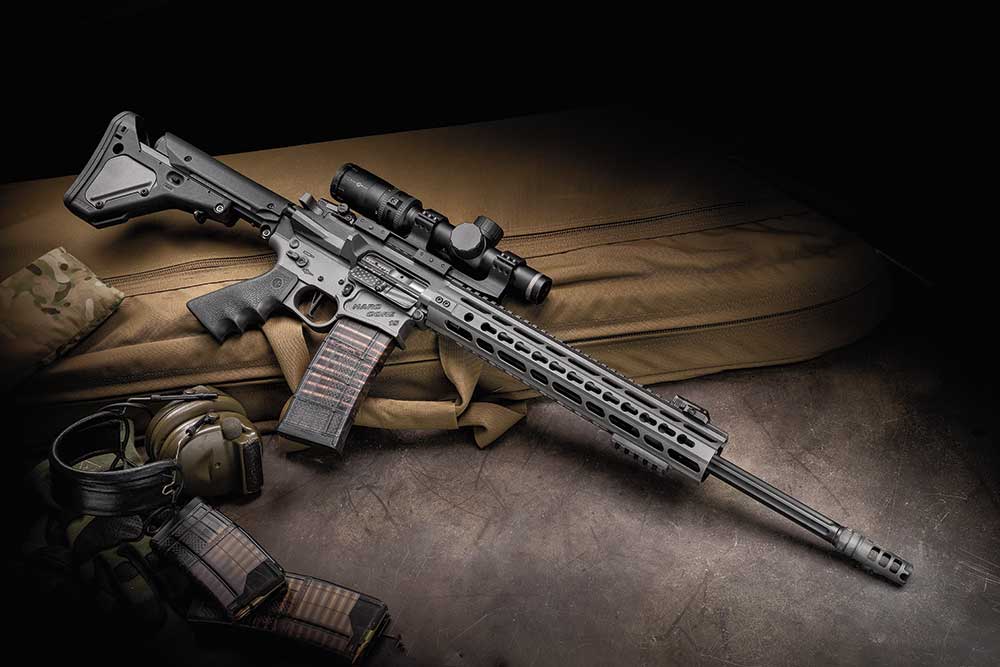


Users can add scopes, lasers, suppressors, slings, and various handles. They can even change out the lower portion of the gun and the magazine allowing for total customization to whatever is best for the user.
How similar do they look? Here’s a Marine aiming an M4 carbine:


In comparison, here’s a civilian holding an AR-15 rifle:


While they have similar looks, the functionality takes one from a military rifle to a civilian version that looks similar, but misses the key military function.

Things the media gets wrong about AR-15 rifles.

The AR-15 is not a “high powered” rifle. Yes, it has more power than a handgun – all rifles do. But when you’re talking about rifles, the AR-15’s .223 / 5.56mm ammunition is considered so low powered that it is banned from hunting large game like deer and elk because it cannot humanely take them down in one shot like most other rifle calibers can.
In some states like Washington, all big game must be hunted with a minimum of .24 caliber ammunition – relegating the AR-15 to small game and varmint duty exactly because it is a low-powered rifle.
Most hunters today choose .308 or .300 Win Mag as their ammunition of choice. The difference in size is clear in this picture:


Politicians and the media not only exaggerate the power of the AR-15, they love to tell the public that it has an almost impossible ability to fire rapidly.
Just hours after the Orlando terror attack, Democratic Congressman Alan Grayson (D-FL), went on CNN and told the audience:


“If [the terrorist] was not able to buy a weapon that shoots off 700 rounds in a minute, a lot of those people would still be alive. That’s exactly right. If somebody like him had nothing worse to deal with than a Glock pistol… he might have killed three or four people and not 50. It’s way too easy to kill people in America today and we have to think long and hard about what to do about that.”
Congressman Grayson’s comments on national television were so farcical as to bring a $50,000 charitable challenge from conservative commentator Conrad Close:


Close is confident in his actions because the AR-15 cannot fire anywhere close to 700 rounds per minute because of its semi-automatic design requiring one trigger press for each round fired.
Most likely, Grayson got the 700 rounds per minute number from the military M-16 and M-4, both of which – when put in fully automatic modes that the AR-15 does not have – shoot at around 700 rounds per minute.

That was far from the anti-gun Congressman’s only factual faux pas of the day, as he claimed “a Glock pistol” can only target “three or four people”, despite the standard magazine for the Glock 17 the terrorist used holding 17 rounds.
Rather than call out Grayson for his falsehoods, CNN’s Erin Burnett agreed and said, “You’re right about that. Thank you very much.”

AR does not stand for Assault Rifle

This one gets its own category because so many people in the media repeat the lie. The “AR” in AR-15 does not stand for Assault rifle in any way. It stands for “ArmaLite Rifle” after the firm that designed the weapon in the 1950s.


Save this for article for the coming weeks as politicians and the media continue to mislead the public through either ignorance, negligence, or malice.

Source:
http://tribunist.com/news/when-you-hear-someone-call-an-ar-15-an-assault-rifle-show-them-this/

Thursday, June 9, 2016

4 Reasons To Add a Pellet Air Gun To Your Survival Gun Arsenal

You read the heading correct – I said Pellet Gun. Yes, the kind powered by air – just 1 step above a BB gun. I own many guns of many calibers and styles for many different purposes. Among these is a good quality Pellet Air Gun and it’s not just because I still have it from when I was a kid. I INTENTIONALLY have added this gun to my survival rifle options for very specific reasons…which I have detailed below.  If you’ve never considered a Pellet Gun as a survival rifle option, you might change your mind after reading this post.
Next to my 12 Gauge Mossberg and my Ruger 10-22 sits a very cool and collected Benjamin Sheridan 392 .22 caliber Multi-Pump Pellet Gun and I treat it with the same respect as it is a very specialized soldier in my arsenal.

Benjamin Sheridan 392 .22 Cal Multi-Pump Pellet Gun

Benjamin Sheridan 392 .22 Cal Multi-Pump Pellet Gun
As a student and instructor of survival living, I take my gun choices very seriously and only add one to my cabinet if it deserves to be there.  Below are 4 reasons (in no particular order) why a Pellet Gun deserves to be including in your Survival Rifle selection:

Survival Reason # 1: Excellent Small Game Hunter

A pellet gun, especially .22 caliber, is an excellent weapon to take down small game.  While people have taken larger game such as wild boars with air guns, they are best suited for small game.  Hunting small game is perfect for any survivalist.  Rabbit, squirrel, dove, quail, duck and the like are excellent food sources and are readily available in most of the country.  With practice, hunting small game with a pellet gun is absolutely no problem.

Small Game Hunter

Small Game Hunter
I have taken many small game animals with my .22 cal pellet gun.  It requires better stalking skills, but that is a good skill to learn anyway.  It requires better shooting skills, but that is also a good skill to hone in on.  Hunting with a pellet gun will force you to be a BETTER hunter and it will also put dinner on the table.  For an interesting photo gallery of pellet gun hunting kills visit: http://www.adventuresinairguns.com/gallery56-i-12.html

Survival Reason # 2: The AMMO

The Pellet Gun’s AMMO is one of the more convincing reasons to have one on hand.  Pellets, no matter the caliber, are very cheap.

.177 cal Pellets - 500 Count for $10

.177 cal Pellets - 500 Count for $10
You can buy 100s of pellets for just a few bucks.  Spend $50 and you’ve got enough to last a lifetime of small game hunting.  If all hell breaks loose, traditional ammunition will become increasingly difficult to get your hands on.  Not to mention that it will be ridiculously expensive.  If the world we live in ever gets this way, why waste your traditional ammo on hunting squirrel or other small game?  That would be wasteful and careless if there was a smarter way.  There is – PELLETS.

1000s of Pellets Fit into Small Spaces

1000s of Pellets Fit into Small Spaces
Not only are pellets DIRT CHEAP, they are very small.  You can carry 1000s and not even know they are there.  You can store 10s of 1000s in just 1 shoe box.  To top it off, pellets have a shelf life of pretty much FOREVER!  Traditional ammunition can go bad over time.  Especially with the talks of giving ammunition an expiration date, stocking a few 1000 pellets isn’t a bad idea.
Worse case scenario you could use all these extra pellets to reload your shot-gun shells.

Reload Empty Shotgun Shells With Pellets

Reload Empty Shotgun Shells With Pellets

Survival Reason # 3: Silent Shooter

Forget the earplugs.  These guns are silent.  In many survival scenarios, a silent weapon is a good thing.  Not only can you hunt without drawing attention to yourself or your family, but shooting a silent weapon often means you can get off more than 1 shot if there are multiple targets.  Both of these are positive.  People pay 1000s of $$$ to make their guns silent.  No extra charge for the pellet gun.

Survival Reason # 4: Powered By Air

You don’t have to buy air.  And, it’s never going to be out of stock.  For this reason, I prefer either a MULTI-PUMP or BREAK-BARREL Pellet Air Gun.  I have opted NOT to purchase a CO2 or pneumatic powered air gun.  Needing to refill canisters or tanks doesn’t make any sense in a survival situation.  You want to keep it as old fashioned as possible.  It’s hand pump all the way for this survivalist.

Break-Barrel Survival Pellet Guns

Break-Barrel Survival Pellet Guns
There are tons of options when it comes to Hand Pump or Break Barrel guns.  They both come in .177 and .22 calibers.  The fps varies depending on the gun.  My Multi-Pump Sheridan shoots 850 fps but there are models out there that shoot upwards of 1250 fps which rivals some rim-fire cartridges.  Like anything, the details are personal choices.  However, I definitely suggest a PUMP or BREAK-BARREL so that you can manually charge your air chamber rather than being dependant on other air supply products.
So there you have it, 4 solid reasons why I keep a Pellet Gun in my survival arsenal.
I hope this has been useful information and as always I would love you hear your thoughts and comments.
Cheers-
Creek

Source:
http://willowhavenoutdoor.com/featured-wilderness-survival-blog-entries/4-reasons-to-add-a-pellet-air-gun-to-your-survival-gun-arsenal/


Wednesday, June 8, 2016

Repurpose a Spoon Into an Arrowhead


This is a neat video that will walk you through the process of repurposing a spoon into an arrowhead. For folks that like diy projects this looks like it would be a nice indoor project. Possibly on a rainy weekend or in the winter when you really don’t want to be outdoors a lot. Brayden Casse shows you each step to make the arrowhead.

From heating and hammering the spoon flat all through the steps to the end where he polishes the arrowhead twice. He says that you don’t need a dremel to do this project but that it would make the job a whole lot easier. If you have an avid bow hunter in your family, imagine the look on their face if you presented them with a dozen of the arrowheads as a gift for a birthday or Christmas. Some folks are hard to buy for. I know a lot of dads get ties and cologne for every occasion.

This would be a great step away from the same ole same ole. They could probably be made into necklaces as well by soldering a loop to one side for a silver chain to go through. You may want to make the point a little dull if you were making a necklace out of the arrowhead though.


Source:


Tuesday, March 29, 2016

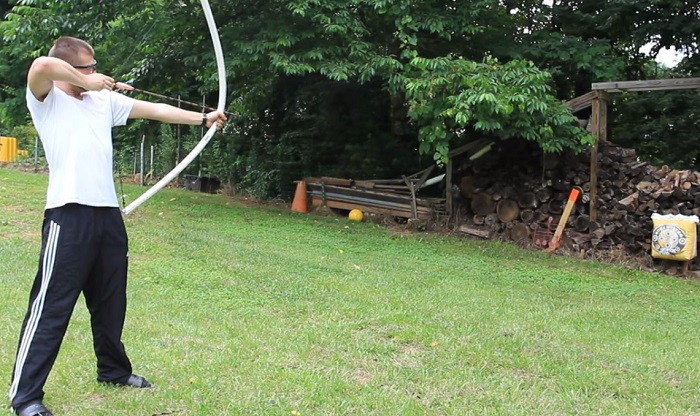
How To Make A Serious Survival Bow From PVC Pipe

The bow is an amazing weapon. Of all the weapons which have been handed down through the centuries, the bow is one of the few ancient weapons that are still in use today. While we don’t see armies taking to the field armed with bows these days, there might be times when using a bow would make more sense than using a rifle. If you want to hunt silently, the bow is the way to go.
In the case of a major disaster with no access to ammunition, it would be natural to revert to the bow for hunting and defense. While shooting a bow accurately requires more practice than shooting a gun, and the range is more limited, it is still a formidable weapon. We should all know how to use a bow as part of our survival training.
Bows were traditionally made of wood, and you can still find some that are made of wood today. In a survival situation, you may want to make a bow out of wood. However, there is a modern material that is excellent for bow making.  PVC pipe is not as attractive as wood, but it can be highly effective.
How To Make A Survival Bow From PVC Pipe
PVC pipe is inexpensive, readily available and easy to use. It also contains potential energy when bent, making it an excellent bow making material. You can mold it using nothing more than your hands and a heat source. On the off chance that you make a mistake forming it, it’s really not a problem. All you have to do is reheat it and form it again. Once cooled, it will hold the new shape, while maintaining its combination of flexibility and rigidity.
PVC Survival Bow Design
PVC bow designs fall into three different categories:
  • Longbow. The longbow is the simplest of all designs. It consists of a straight piece of pipe, which has been drilled at both ends for it to be strung. When the bow is strung, the pipe is bent to form an ark.
  • Recurve bow. The recurve bow is probably the best combination for PVC. The curved arms and reverse curved tips greatly increase the potential energy stored in the bow, while making it more compact and easier to use.
  • Compound bow. Modern hunting bows are compound bows with a pulley attached to each end of the arms. This design allows much more force to be stored in the bow, while making drawing and holding the bow easier.
Theoretically, PVC bows can be made out of any size PVC pipe. but reality poses some limitations on us. While I have seen a few longbows made out of one inch diameter pipe, most are made of 3/4 inch, schedule 40 pipe. This pipe provides a nice balance between rigidity and flexibility. Don’t use thin-wall PVC, as it isn’t strong enough to provide any true energy when released. It is also much more likely to kink when the bow is drawn.
Making the PVC Recurve Bow
The basic difference between the recurve bow and a simple bow made out of straight PVC pipe is that the recurve bow is curved to increase the amount of velocity it can transfer to the arrow. This curve is made by heating the PVC with a heat gun, bending it to the desired shape and holding it there while it cools. No special tools or jigs are needed, with the exception of the heat gun and one large can.
New Mini Pocket Power Plus Can Charge All Your Electronics — And Jump Start Your Car!
I used a four-foot  piece of 3/4 inch, schedule 40 PVC pipe for my bow. You can use a longer piece if you like (up to six feet long), but I wanted a compact bow. Mark the center four inches of the bow, as that will be your handle. Also mark eight inches from each end, as those will be the curved tips.
How To Make A Survival Bow From PVC Pipe
The first bend is to make the main curve of the bow arms. You will be heating and bending one arm at a time. Heat the section from the edge of the handle to the mark for the curved tip, stopping a little short of the curved tip. Rotate the PVC as you are heating it, so that it heats evenly all the way around.
Please note that if you are heating the PVC with a back and forth movement of the heat gun, you will end up heating the ends of the stroke more than the middle. Make a portion of your strokes shorter (about 1/4 of them), covering just the center of the area, to ensure even heating.
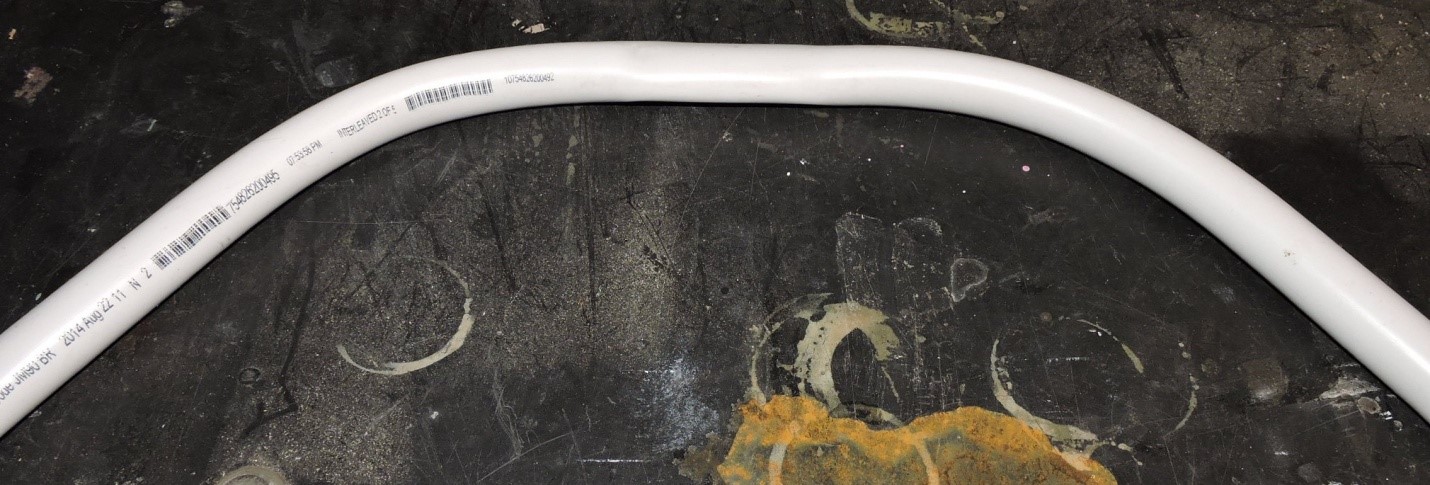
Once the PVC has softened, bend it to form a curve. This curve should make the end of the arm point about 45 degrees from the original direction. Perform the bending on a flat surface, such as a workbench top, to ensure that you keep the entire bow on the same plane and to avoid a corkscrew shape. Hold until it cools, and then repeat for the other side.
It can help to mark the actual curve you end up with from the first bend on a piece of cardboard, so that you can use that location as a template for the other side. That way, you can ensure that both arms are bent evenly.
How To Make A Survival Bow From PVC Pipe
With the primary bend in the two arms, it is time to reduce the amount of depth of the bow by recurving it at the handle. This will be a short bend, only heating the four inches of pipe that is directly adjacent to the handle. Push the curve back in the other direction, making a bump in the overall geometry of the bow.
Please note that we haven’t changed the original curve of the arms by doing this; we have just changed the beginning of the curve. Since the rest of the curve hasn’t been heated, it shouldn’t change.
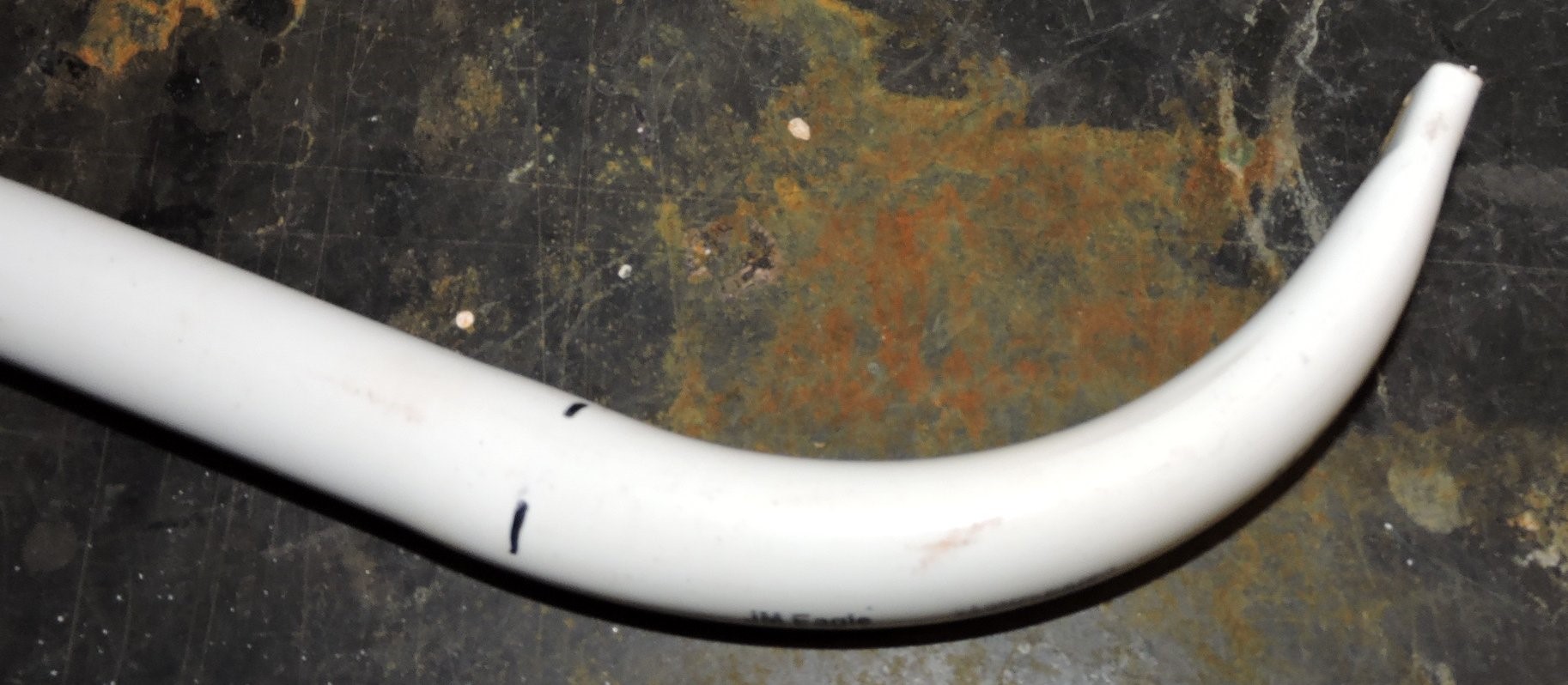
The next step is to recurve the ends. In the process, they will become somewhat flattened. Many people do this by flattening them first and then curving them. I find it easier to just curve them, allowing the flattening actions to come about as a natural part of curving the piece. This also makes the transition from round to flat gradual, eliminating stress points.
How To Make A Survival Bow From PVC Pipe
To recurve the ends, you’ll need a coffee can or other large can and a vice. I used a woodworking vice in the picture, but you can use any large vice you have available. If you don’t have a vice available, you can hold it by hand as long as you are wearing insulated gloves.
Heat the end eight inches of the arm. Clamp the last 3/4 inch of it in the vice, with the coffee can and bend the pipe around the can. You want about a 90 degree angle between the tip of the arm and the end of that recurve. Since the idea here is to recurve the bow, the direction of the curve should be the opposite of the main curve of the arm. The flat at the end should be crosswise to the plane of the bow, so that when you are holding it, you see the flat and not the edge of the flat.
You need to be very careful at this point, as it is easy to make this bend in such a way that the tip goes off to one side, rather than being on line with the bow. If that mistake happens, the problem can be rectified by reheating the pipe just at the beginning of the tip recurve and adjusting it to align with the rest of the bow.
Allow the pipe to cool and then remove it from the vice. Repeat for the other end. If the very end of the pipe is not totally flattened or if it still has an opening after recurving the tips, you may want to reheat just the very tips and flatten them again.
How To Make A Survival Bow From PVC Pipe
The ends of the bow arms need to be notched to hold the cord. This can be done by drilling 1/4 inch holes through the flat of the ends. Then, cut the material out between the hole you just drilled and the edge of the flat on the pipe.
You can paint the finished PVC pipe bow as desired to make it harder to see when you are stalking game through the woods.
How To Make A Survival Bow From PVC Pipe
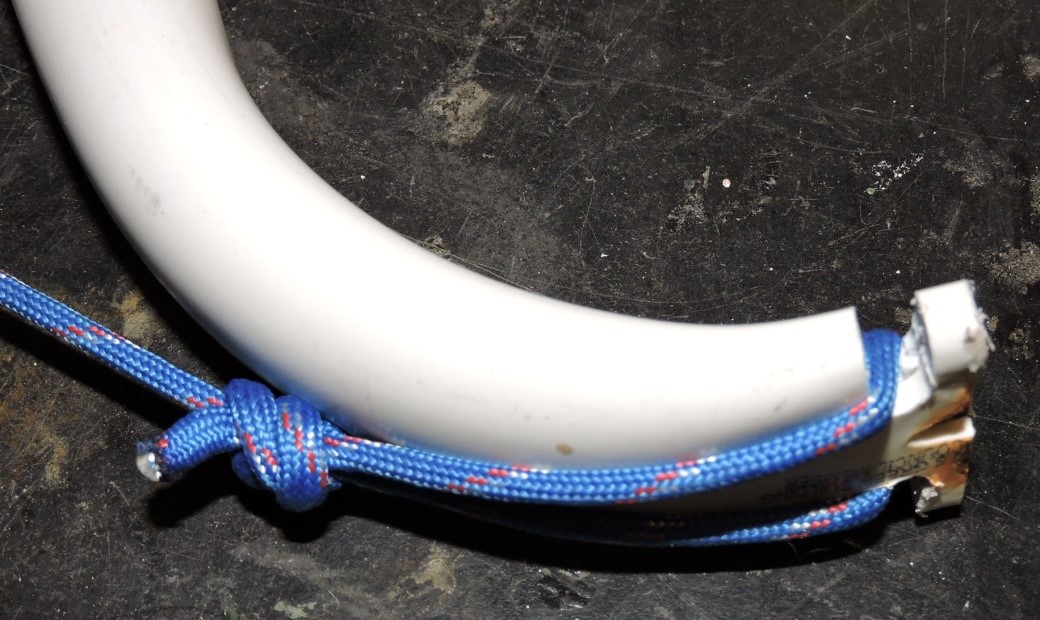
The last step is to put a string on your bow. If I was planning on using this bow regularly, I would have a real bowstring made for it. But since this is a survival bow, I’m going to use something that I would normally have on hand in a survival situation —   paracord. Tying a loop on each end of the paracord allows it to be attached to the ends of the arms, where it can be held in place by the loops. The cord should be a little shorter than the natural span of the bow, so that you have to bend it slightly to string it.
You will notice in this picture that the PVC at the tip of the arm is somewhat brown. This is what happens if you overheat the PVC while working it. That happened while I was reheating the PVC to flatten the ends.
By following these steps, you will have created an inexpensive and durable bow. Now you know that you can build an effective survival weapon with materials you already have on hand in your home.
Have you ever made a PVC bow? What tips would you add? Share them in the section below:

Source:
http://www.offthegridnews.com/extreme-survival/how-to-make-a-serious-survival-bow-from-pvc-pipe/