
I enjoy incorporating locally foraged plants into our daily diets.
It supplements, and occasionally replaces, a meal at my house. It also gives me another “tool” in my tool belt of survival skills.
What piqued my interest in this subject and how did it all begin?
After the bank crisis of 2007-2008, I began to think there could be a possibility that our currency wouldn’t be worth anything someday. I wanted an alternative way of providing for my
family. If hyperinflation occurred, I may not be able to afford groceries at the store. What could I do?
If I could learn how to find wild edibles, we could be more self-sustaining until things got back to normal. I’ve heard many people say they would just hunt for their food, but what if over 200 million other people are doing the same thing?
We would quickly run out of animals.
In addition, a meat-only diet isn’t very appealing, nor is it nutritionally optimal. At the very least, most meals need some herbs and spices! I wanted to learn what plants, trees, shrubs, and flowers could be resources for me.
Learning how to forage
Of course I went online and learned about plants for food and medicine. I talked to my local county extension office and spoke to “experts” in many areas. I found that nobody would teach me about mushroom hunting due to the liabilities. (It’s too easy for newbies, especially, to mis-identify and think a poisonous mushroom is safe to eat.)
I looked for places to go that offered “Hands-on” learning that were free or had a minimal cost. I also wanted to meet local people that had useful skills that were willing to share their knowledge. I especially wanted to meet “my own kind”. I hoped maybe we could form a group and share what we learned.
Around 2010, things started happening. I found an awesome place called Willow Haven Outdoors in Anderson, Indiana that offered a FREE “Skills Day” once per year to showcase survival skills and techniques. I learned how to operate a bow drill, make a grote (fish hook carved from bamboo), observe flint knapping, and making three prong spear to impale fish. I would go down once or twice per year to learn things and buy survival gear. It is operated & owned by Creek Stewart. He now has a show on the Weather Channel called “
Fat Guys in the Woods”.
Then in 2012, my friend, Madelynn and I began our own preppers group, North West Indiana Preppers. We wanted to prepare for man-made and natural disasters. We wanted to get a group of people with a variety of skills that could help teach self-reliance.
It was awesome to have like-minded people to talk to and learn from. One of our members, John, taught me how to build a solar cooker from a Fresnel Lens from my old TV. Another member, Bill, taught me how to tap Maple Trees, Creek Stewart came and took us into the woods to hunt for Wild Edibles, and many, many more events.
Surround yourself with people smarter and more knowledgeable than you!
It is very easy to mis-identify mushrooms and eat something poisonous unless you really, truly know what you are doing, which is why it can be so hard to find anyone willing to teach this skill. PLEASE exercise extreme caution if you choose to do this yourself.
I still wanted to mushroom hunt, so I joined the Indiana
Mycological Society. (There are regional and state clubs from Mexico to Canada.) I get great information, photos, and advice from them. They also take people into the woods to hunt mushrooms that are in season. Another wonderful resource is
Taltree Arboretum in Valparaiso, IN. They have edible plant tours, mushroom walks, and cool gardens. There is a small fee for the guided hands on learning, but it is well worth it.
Probably the most valuable investments are a great field guide and spending time in different types of terrain to locate plants in your book. I always have the
Peterson Field Guide to Medicinal Plants and Herbs of Eastern and Central North America by Steven Foster and James Duke in my car. (There is also one for
western North America.) It has glossy colored photos accompanied by great descriptions of the plants and their many uses.
Last summer and fall, I spent a great deal of time in the woods around my subdivision, armed with a smart phone and my
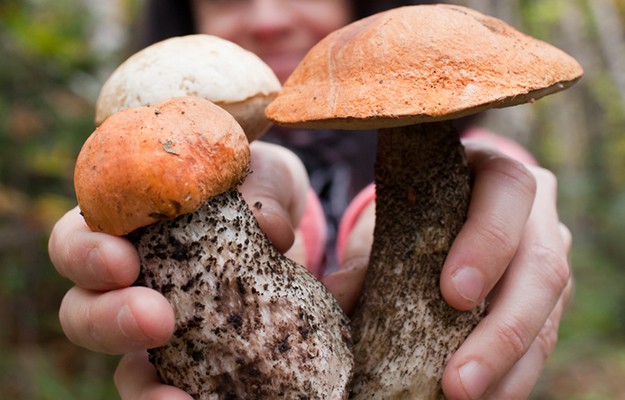
Field Guide. I would pick a mushroom or two, then find a place to sit, study, and photograph my finds. If I felt I could positively identify a mushroom, I would be the first one to eat it. I can’t figure them all out, but I can harvest Sheepshead, Chicken of the Woods, Puffballs, Oysters, Boletes, and an unusual one called
Purple-gilled Laccaria.
I learned how to perform a “spore test” when the color of the spore is a critical factor in identification. I would get two of each kind of mushroom, placing one on a piece of black paper and one on white paper. Then I set a drinking glass over each one. In a few hours, remove the glass, and you will see a beautiful spore pattern appear. You need to see the spore color for identification of some mushrooms.
I also deliberately spread the edible mushroom spores in as many locations as I can to increase their numbers. Simply cut a mushroom into a few pieces, and insert the pieces gill side down onto a type of wood that they are partial to, and new mushrooms will grow there.
Be your own “Johnny Appleseed” and plant a few secret gardens in off the beaten path locations using heirloom perennial seeds. If someone takes all your stuff or takes over your property, you still have these little “hidden gardens”.
Insects
For more foraging options, consider insects. There is a reason people in dire circumstances are often seen eating them:
We will never run out of insects.
Last summer I served guests
dandelion and bacon soup for dinner, and dessert was a delicious protein bar made with
CRICKET flour. Cricket flour is 60% protein, and when it’s mixed in with chocolate, peanut butter, coconut, or lime, it’s really good. The company that made these bars is called “
Chapul”. You can order them online, but I just wanted to introduce this idea to you, in case you ever need another source of protein. It’s gluten free and doesn’t taste any different than “regular” flour.
Resources All Around
I know my area pretty well. Get to know yours, too. I located walnut and
hickory trees, so I have a source for nuts. (These aren’t the easiest
nuts to crack, so be prepared with a good
nutcracker or two.) I can also use the hickory bark to smoke meat. I’ve found numerous mulberry trees and made syrup, jam, and jelly with some friends. I have apple trees with small sour apples that are great for making apple cider vinegar.
TIP: Take an inventory of the plants in your area. Learn more
here.
I know where there are a few creeks not far from me. So, I have a water source, but also found crayfish, and don’t forget, animals need water, too. You can hunt close to the water, eventually, they will all come there.
I located raspberry bushes, cattails, wild asparagus,
stinging nettles for medicinal tea, dandelion leaves (blanch them and they taste like a delicate spinach), elderberries, I have honeybees, Queen Anne’s lace for making jelly, my maple trees for making syrup, white willow for making salicylic acid (aspirin) in my own yard, and those “Helicopter” type seeds that come from maples are edible (toast them first). There are just too many to list here!
Final Thoughts
When I reflect back on all the
weeds I’ve pulled, I can’t believe how many were actually edible plants! My garden was loaded with purslane, lambs quarter and plantain. I eat the first two while they are still young and tender, and use plantain as a poultice for skin irritation or injuries.
All these amazing resources are probably all around you, and you may not realize it.
Start looking and learning now, before anything bad happens.
My main points for anyone wanting to learn about foraging are:
. It’s never too late to start. Learn at least a few new things.
. Look for resources to help you. It can be people, books, groups, or the internet.
. But be prepared to learn by yourself if no one else is interested.
. Learn to identify local wild edibles (plants, trees, nuts, herbs, mushrooms).
. Learn to prepare these items and eat them.
. Become the Resource Person.
The Forager's Harvest: A Guide to Identifying, Harvesting, and Preparing Edible Wild Plants Foraging: For Beginners - The Ultimate Guide To Foraging Wild Edible Plants And Medicinal Herbs For Optimum Health and Longevity! (Homesteader Book, Foraging, Wildcrafting)
 A Field Guide to Edible Wild Plants: Eastern and central North America (Peterson Field Guides)


 The DIY Cinder Block Rocket Stove is an incredibly simple and efficient way to cook using natural fuel such as leaves or sticks. The beauty of this design is it focuses all of the heat from the fire into one 4″ by 4″ square which is perfect for cooking. Compare this to a traditional camp fire which radiates the heat in all directions. Rocket stoves can also burn much hotter than traditional camp fires because of the constant air flow. As the hot air rises, fresh air is sucked in to replace it which allows the fuel to burn more rapidly.




 I enjoy incorporating locally foraged plants into our daily diets. It supplements, and occasionally replaces, a meal at my house. It also gives me another “tool” in my tool belt of survival skills.


