});

Tuesday, June 14, 2016

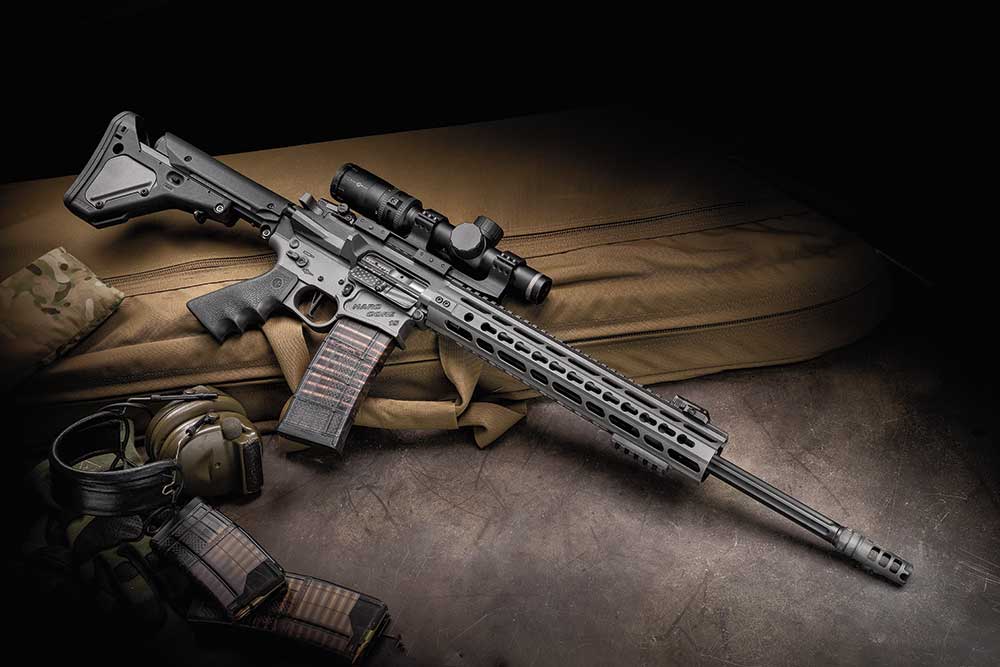
The AR-15 Is NOT An Assault Rifle


The Orlando terrorist made the AR-15 his weapon of choice to slaughter 49 innocent Americans inside the Pulse nightclub in downtown Orlando, Florida. That act of terrorism has caused media outlets and anti-gun politicians to call the AR-15 the “mass shooter’s weapon of choice” and renewed calls for a ban on assault rifles.


[scroll down for video]
Yet by any definition of the term, the AR-15 is not an assault rifle – it simply is not capable of doing what an assault rifle does.

What defines an assault rifle?

There are many criteria such as the use of detachable magazines (something almost all modern firearms do), and the use of an intermediate cartridge such as the .223 or 5.56 caliber ammunition used by an AR-15.
But the primary difference between an AR-15 style modern sporting rifle and an assault rifle is selective fire – the ability to switch from semi-automatic and fully automatic fire.


The AR-15 rifle is a gas powered, semi-automatic rifles which means that one press of the trigger results in one round being fired. The United States military uses weapons like the M-16 and the M4 that both look like an AR-15 but provide both fully automatic fire and three-round burst fire – both of which are not possible with an AR-15.


Just because they look the same, doesn’t mean they function the same.

The AR-15 looks almost identical to the M16 and M4 carbine assault rifles for a very simple reason. It’s an almost ideal rifle with exceptional ergonomics and design — almost like the military spent millions of dollars and decades working on the design and refining it to be a very high quality rifle. Oh wait, they did.
Beyond the ergonomics and functionality, what draws people to the AR-15 is that it is heavily customizable like it’s similar looking but very differently functioning military cousins.


Users can add scopes, lasers, suppressors, slings, and various handles. They can even change out the lower portion of the gun and the magazine allowing for total customization to whatever is best for the user.
How similar do they look? Here’s a Marine aiming an M4 carbine:


In comparison, here’s a civilian holding an AR-15 rifle:


While they have similar looks, the functionality takes one from a military rifle to a civilian version that looks similar, but misses the key military function.

Things the media gets wrong about AR-15 rifles.

The AR-15 is not a “high powered” rifle. Yes, it has more power than a handgun – all rifles do. But when you’re talking about rifles, the AR-15’s .223 / 5.56mm ammunition is considered so low powered that it is banned from hunting large game like deer and elk because it cannot humanely take them down in one shot like most other rifle calibers can.
In some states like Washington, all big game must be hunted with a minimum of .24 caliber ammunition – relegating the AR-15 to small game and varmint duty exactly because it is a low-powered rifle.
Most hunters today choose .308 or .300 Win Mag as their ammunition of choice. The difference in size is clear in this picture:


Politicians and the media not only exaggerate the power of the AR-15, they love to tell the public that it has an almost impossible ability to fire rapidly.
Just hours after the Orlando terror attack, Democratic Congressman Alan Grayson (D-FL), went on CNN and told the audience:


“If [the terrorist] was not able to buy a weapon that shoots off 700 rounds in a minute, a lot of those people would still be alive. That’s exactly right. If somebody like him had nothing worse to deal with than a Glock pistol… he might have killed three or four people and not 50. It’s way too easy to kill people in America today and we have to think long and hard about what to do about that.”
Congressman Grayson’s comments on national television were so farcical as to bring a $50,000 charitable challenge from conservative commentator Conrad Close:


Close is confident in his actions because the AR-15 cannot fire anywhere close to 700 rounds per minute because of its semi-automatic design requiring one trigger press for each round fired.
Most likely, Grayson got the 700 rounds per minute number from the military M-16 and M-4, both of which – when put in fully automatic modes that the AR-15 does not have – shoot at around 700 rounds per minute.

That was far from the anti-gun Congressman’s only factual faux pas of the day, as he claimed “a Glock pistol” can only target “three or four people”, despite the standard magazine for the Glock 17 the terrorist used holding 17 rounds.
Rather than call out Grayson for his falsehoods, CNN’s Erin Burnett agreed and said, “You’re right about that. Thank you very much.”

AR does not stand for Assault Rifle

This one gets its own category because so many people in the media repeat the lie. The “AR” in AR-15 does not stand for Assault rifle in any way. It stands for “ArmaLite Rifle” after the firm that designed the weapon in the 1950s.


Save this for article for the coming weeks as politicians and the media continue to mislead the public through either ignorance, negligence, or malice.

Source:
http://tribunist.com/news/when-you-hear-someone-call-an-ar-15-an-assault-rifle-show-them-this/

Thursday, June 9, 2016

4 Reasons To Add a Pellet Air Gun To Your Survival Gun Arsenal

You read the heading correct – I said Pellet Gun. Yes, the kind powered by air – just 1 step above a BB gun. I own many guns of many calibers and styles for many different purposes. Among these is a good quality Pellet Air Gun and it’s not just because I still have it from when I was a kid. I INTENTIONALLY have added this gun to my survival rifle options for very specific reasons…which I have detailed below.  If you’ve never considered a Pellet Gun as a survival rifle option, you might change your mind after reading this post.
Next to my 12 Gauge Mossberg and my Ruger 10-22 sits a very cool and collected Benjamin Sheridan 392 .22 caliber Multi-Pump Pellet Gun and I treat it with the same respect as it is a very specialized soldier in my arsenal.

Benjamin Sheridan 392 .22 Cal Multi-Pump Pellet Gun

Benjamin Sheridan 392 .22 Cal Multi-Pump Pellet Gun
As a student and instructor of survival living, I take my gun choices very seriously and only add one to my cabinet if it deserves to be there.  Below are 4 reasons (in no particular order) why a Pellet Gun deserves to be including in your Survival Rifle selection:

Survival Reason # 1: Excellent Small Game Hunter

A pellet gun, especially .22 caliber, is an excellent weapon to take down small game.  While people have taken larger game such as wild boars with air guns, they are best suited for small game.  Hunting small game is perfect for any survivalist.  Rabbit, squirrel, dove, quail, duck and the like are excellent food sources and are readily available in most of the country.  With practice, hunting small game with a pellet gun is absolutely no problem.

Small Game Hunter

Small Game Hunter
I have taken many small game animals with my .22 cal pellet gun.  It requires better stalking skills, but that is a good skill to learn anyway.  It requires better shooting skills, but that is also a good skill to hone in on.  Hunting with a pellet gun will force you to be a BETTER hunter and it will also put dinner on the table.  For an interesting photo gallery of pellet gun hunting kills visit: http://www.adventuresinairguns.com/gallery56-i-12.html

Survival Reason # 2: The AMMO

The Pellet Gun’s AMMO is one of the more convincing reasons to have one on hand.  Pellets, no matter the caliber, are very cheap.

.177 cal Pellets - 500 Count for $10

.177 cal Pellets - 500 Count for $10
You can buy 100s of pellets for just a few bucks.  Spend $50 and you’ve got enough to last a lifetime of small game hunting.  If all hell breaks loose, traditional ammunition will become increasingly difficult to get your hands on.  Not to mention that it will be ridiculously expensive.  If the world we live in ever gets this way, why waste your traditional ammo on hunting squirrel or other small game?  That would be wasteful and careless if there was a smarter way.  There is – PELLETS.

1000s of Pellets Fit into Small Spaces

1000s of Pellets Fit into Small Spaces
Not only are pellets DIRT CHEAP, they are very small.  You can carry 1000s and not even know they are there.  You can store 10s of 1000s in just 1 shoe box.  To top it off, pellets have a shelf life of pretty much FOREVER!  Traditional ammunition can go bad over time.  Especially with the talks of giving ammunition an expiration date, stocking a few 1000 pellets isn’t a bad idea.
Worse case scenario you could use all these extra pellets to reload your shot-gun shells.

Reload Empty Shotgun Shells With Pellets

Reload Empty Shotgun Shells With Pellets

Survival Reason # 3: Silent Shooter

Forget the earplugs.  These guns are silent.  In many survival scenarios, a silent weapon is a good thing.  Not only can you hunt without drawing attention to yourself or your family, but shooting a silent weapon often means you can get off more than 1 shot if there are multiple targets.  Both of these are positive.  People pay 1000s of $$$ to make their guns silent.  No extra charge for the pellet gun.

Survival Reason # 4: Powered By Air

You don’t have to buy air.  And, it’s never going to be out of stock.  For this reason, I prefer either a MULTI-PUMP or BREAK-BARREL Pellet Air Gun.  I have opted NOT to purchase a CO2 or pneumatic powered air gun.  Needing to refill canisters or tanks doesn’t make any sense in a survival situation.  You want to keep it as old fashioned as possible.  It’s hand pump all the way for this survivalist.

Break-Barrel Survival Pellet Guns

Break-Barrel Survival Pellet Guns
There are tons of options when it comes to Hand Pump or Break Barrel guns.  They both come in .177 and .22 calibers.  The fps varies depending on the gun.  My Multi-Pump Sheridan shoots 850 fps but there are models out there that shoot upwards of 1250 fps which rivals some rim-fire cartridges.  Like anything, the details are personal choices.  However, I definitely suggest a PUMP or BREAK-BARREL so that you can manually charge your air chamber rather than being dependant on other air supply products.
So there you have it, 4 solid reasons why I keep a Pellet Gun in my survival arsenal.
I hope this has been useful information and as always I would love you hear your thoughts and comments.
Cheers-
Creek

Source:
http://willowhavenoutdoor.com/featured-wilderness-survival-blog-entries/4-reasons-to-add-a-pellet-air-gun-to-your-survival-gun-arsenal/


Wednesday, June 8, 2016

Repurpose a Spoon Into an Arrowhead


This is a neat video that will walk you through the process of repurposing a spoon into an arrowhead. For folks that like diy projects this looks like it would be a nice indoor project. Possibly on a rainy weekend or in the winter when you really don’t want to be outdoors a lot. Brayden Casse shows you each step to make the arrowhead.

From heating and hammering the spoon flat all through the steps to the end where he polishes the arrowhead twice. He says that you don’t need a dremel to do this project but that it would make the job a whole lot easier. If you have an avid bow hunter in your family, imagine the look on their face if you presented them with a dozen of the arrowheads as a gift for a birthday or Christmas. Some folks are hard to buy for. I know a lot of dads get ties and cologne for every occasion.

This would be a great step away from the same ole same ole. They could probably be made into necklaces as well by soldering a loop to one side for a silver chain to go through. You may want to make the point a little dull if you were making a necklace out of the arrowhead though.


Source:


Monday, June 6, 2016

More Snares and Traps DIY

diy small game survival snare for hunting in wilderness
How to Build a Small Game Survival Snare:

Editor’s note: This is a guest post from Creek Stewart of Willow Haven Outdoor.
I practice and learn survival skills not because I need them on a daily basis, but rather for the one day when I must use them to stay alive.  Survival is the intersection between knowledge and necessity.    The outcome in a survival scenario can be dramatically influenced by practicing survival skills before you need them.  One such skill that requires thoughtful practice is How to Build a Small Game Survival Snare.  A primitive make-shift snare can be used to trap and kill a variety of animals for food in a survival situation.  This basic concept can also be modified and used as a “man-trap” or “perimeter alarm”–both of which are commonly deployed in guerrilla warfare.
While constructing a survival snare is fairly simple, it is often oversimplified with vague instructions and limited photos.  By the time you finish reading this article you will know the who, what, why, when, where, and how of the simplest and most efficient survival snare known to man.  If your knowledge ever crosses paths with necessity, this may prove useful.

The Why

For short term survival (1-7 days), food is not a critical priority.  Shelter, water, fire, and signaling are typically more immediate concerns.  At some point, though, you must put calories on the human furnace or suffer the debilitating consequences of starvation.
To my knowledge there isn’t one single primitive culture, tribe, or people where meat is/was not a critical component of their diet.  Modern equipment, farming, transportation, food processing, supplements, and complex supply chains give us the option not to eat meat if we choose.  Remove these luxuries for an extended period of time and the calories from meat once again become necessary for survival.  It would be extremely difficult, if not impossible, to source enough calories in a primitive survival scenario by gathering wild plant edibles alone–especially in cold weather climates or seasons.
Time and energy conservation are both very important factors to consider in any survival situation.  This is precisely why snares are such an important survival tool.  Once constructed and set, a snare will allow you to focus on other survival priorities.  And, it will keep working even while you are sleeping.  With 10 snares you can be hunting in 10 different locations at the same time while expending ZERO energy.  You become a one man hunting party.  Snares are a survivor’s secret weapon.  Not only are snares incredibly reliable and effective, they also require very few resources to build–in materials, energy, and time.

The Who

Before you even think about spending time and energy on building and setting a snare, you must first determine whom (or in this case which animal) your snare is targeting.  For survival purposes, small game represents your best chance of success.  While the snare design I will show you can be scaled up to catch animals as large as deer, it is more practical to target small game animals such as rabbit, squirrel, and ground dwelling fowl such as quail or grouse.  This snare can also be modified to fish for you as well.  Not only are smaller game animals easier to catch and field dress, but you can set numerous small game snares with the same time and material resources it would cost you to set one larger snare.  Setting snares is a numbers game.  The more snares you set, the greater your odds of success.

The When and Where

This snare can be effective in virtually any climate and any environment on any continent.  It can be deployed any time of the year and is equally effective day and night.  From desert to rain forest, I can’t think of a place where you can’t use some version of it to catch small game.
With that said, placing random snares throughout the woods is foolish and a waste of time and energy.  Though they can be baited to draw in animals, snares are most effective when strategically placed in-line with existing small game trails.  As you will see in the HOW section of this article, the heart of this snare is a noose which should be positioned across a frequently traveled small game path or shelter entrance such as a den or burrow.
To be successful, you must read the forest or terrain in which you find yourself.  You must look for signs of small game traffic and activity.  These signs include scat (droppings), tracks, rubs, scratches, signs of feeding, shelter or burrow entrances, food and water sources, and well-traveled game trails.
I took a walk in the forest here at Willow Haven Outdoor and snapped a few photos of some telltale animal signs that should catch the eye of a passing survivor.  See if you can identify the small game activity in these photos below:

small animal burrow hole entrance under leaves
game animal tracks through snow woods

small animal scat dropping on forest floor leaves


The best place for the snare I detail in the next section is across a well-traveled small game path.  These paths, called “runs,” typically lead from the nest, shelter, or den to water and food sources.  Animals are the ultimate survivors and also live by the survival code of energy conservation.  Consequently, several animals may travel the same trail or path on a regular basis.  Animals travel the path of least resistance and strategically placed snares along this path can be very effective.

Finally…The What and the How

There are literally hundreds of different snare sets and designs–some of which are overly complex.  If you only learn one snare design in your life, it should be what I call the Trigger Spring Snare.  I wish I could take credit for the design, but it dates back to the beginning of mankind and versions of it have been used by primitive people in all parts of the world.  It has been time-tested, field-tested and survival-tested.  It is my #1 GO-TO Survival Snare set.
The Trigger Spring Snare consists of 4 components which can be readily sourced in nearly any survival situation.  These components are:
  1. The Noose (made from some kind of cordage–preferably wire)
  2. The 2 Part Trigger (carved from wood)
  3. The Leader Line (also made from some kind of cordage)
  4. The Engine (typically a bent over sapling)

The Noose

The noose does exactly what you think–it nooses the animal.  The most effective noose material is wire.  There are many different types of wire that will work.  The wire must be flexible.  It cannot be too thick or brittle.  When set in the shape of a noose (shown later), it must tighten easily and quickly when pulled upon.  Some examples are:
  • Twisted copper strands from the inside of an everyday lamp or small appliance power cord
  • Picture hanging wire
  • Stripped wire from car or vehicle electrical systems
  • Craft wire
  • Headphone wire
  • Wire from a spiral bound note pad
  • An uncoiled spring (such as in a ballpoint click pen)
  • Wire reinforced bras
  • Wire from inside electronics such as toys, phones, and radios
rope wire options for building small game snare hunting

If wire is unavailable, some kind of string or cord will have to do.  It must be strong enough to hold a 5-8 lb animal.  If it snaps under the force of a couple jerks between your fists then it probably won’t work well.

jerk the rope to test durability for small game hunting snare

Here are several alternative cordage ideas:
The inner strands from 550 Parachute Cord
  • Shoe strings
  • Dental floss
  • Fishing line
  • Unwoven webbing
  • Strong stitching material such as what is used to sew together leather and outdoor goods such as purses, wallets, cell phone cases, belts, jackets, and backpacks
rope samples for building constructing small game snare

If no modern wire or cordage is available, there are many natural plants and tree bark fibers that can be fashioned into suitable cordage.  Several excellent cordage plants/trees are:
  • Milkweed
  • Dogbane
  • Stinging nettle
  • Many inner tree barks such as cedar and elm
  • Palm
  • Cattail
Below is a photo of several cords made from reverse wrapping plant and tree bark fibers.  Remember, primitive cultures used this snare for hundreds of years with no modern wire or rope.  It takes more time and knowledge but is certainly possible.

natural rope cordage grass bark strings for small game snare

The average length of your noose cord needs to be 18-24 inches for most small game animals.  To construct your noose you need to make a small loop in one end about the diameter of a pencil.  With wire you can simple make the loop and twist the wire back on itself several times.


With string, simply fold the end back onto itself and tie an overhand knot to secure the loop.


Then, run the other end of the cord/wire through the loop to create your noose.  The tag end is then tied to your trigger as is detailed in the next section.

The Trigger and Leader Line

The trigger consists of 2 parts: the HOOK and the BASE.  As you can see in the diagram below, the LEADER LINE is tied to the top of the HOOK and the NOOSE is tied to the bottom of the HOOK.  The ENGINE (typically a bent over sapling) provides tension to the HOOK which is secured under the BASE–until an animal disengages it by pulling on the NOOSE.  The LEADER LINE from the HOOK to the ENGINE can be any type of cordage.  It needs to be strong enough to withstand the initial “spring jerk” and then the weight of the suspended (and struggling) animal.


Several Trigger Modifications

When it comes to this style of trigger, don’t limit yourself to one exact model.  The same result can be accomplished in many similar ways.  You may have to improvise in a survival scenario.  It is the principle that is important.  Below are several trigger modifications that I worked up to give you a few ideas.
CARVED TRIGGER


This trigger style is simply carved from 2 hard wood sticks.  Notice the BASE of the trigger system that is staked into the ground.  The noose in the photo above is made from the inner strands of 550 paracord.  Below is another photo of a carved trigger snare.  This noose is made from the copper wires from inside an old lamp cord which makes an ideal noose material.  Notice how I’ve used little twigs to hold my noose in place.  This can be helpful to keep your noose exactly where you want it.


PRIMITIVE “Y” STICK TRIGGER


This trigger requires very little carving– simply find 2 sticks that branch how you need them and let nature provide your trigger system.  The noose in this photo is made from the fibers of a raffia palm tree.  This BASE is also staked into the ground.
PEG STYLE TRIGGER


Rather than having a BASE that is staked in the ground, the HOOK of this trigger system is secured on a peg or nail that you can place in a nearby log, stump, or tree.  I’ve even created triggers that have hooked onto nearby rock ledges.  This photo also features a “baited trigger.”  I have sharpened the bottom of the hook and stuck on a piece of bait (raisin) to lure an animal through the noose.  As soon as the bait is tampered with, the HOOK disengages.  Make sure the animal must put its head through the noose to access a baited trigger.

Fishing Modification

This same trigger snare principle can be used with a hook and line for fishing as well.  Instead of using a noose, attach your fishing line to the bottom of the HOOK TRIGGER.  When a fish pulls your line and disengages the trigger, the ENGINE will pull and set the hook in the fish’s mouth.  Make sure your TRIGGER HOOK is just barely set so that the slightest tug from a nibbling fish engages the ENGINE.  See the diagram below:


The Engine

Every environment is different and unique.  There may not be a sapling to bend over along a game trail.  Or, you may be in the middle of a prairie or field where there are no trees at all.  If so, you must improvise.  There are many ways to do this.  One way is to simply cut down a green sapling or branch from another area and stake it in the ground to use as an ENGINE.  Your LEADER LINE can also be weighted and run over a branch or make-shift tripod to serve the same purpose.  In the photo below I’ve weighted the LEADER LINE with a 10 pound rock that applies tension to the TRIGGER.  I used the bark from a root as the LEADER LINE and a NOOSE made from braided cattail leaves–this is a 100% primitive snare set.


In the set below, I used a similar principle except I erected a make-shift tripod to serve as an anchor point for the LEADER LINE.  Here, the LEADER LINE is a high visibility 550 Paracord.


Your ENGINE (whether a sapling, branch, or weighted system) should be powerful enough to suspend a small game animal in the air.  This helps to ensure a faster and more humane kill and also keeps your catch away from other predators who would certainly be very interested in a free meal.  If in doubt, you can test your snare ENGINE by using a 6-8 pound rock or log.
A NOTE ABOUT TIME AND ENERGY CONSERVATION:
The NOOSE from this snare system can be an incredibly effective snare by itself–without a TRIGGER or ENGINE.  By securing the tag end of the NOOSE to a stake or tree and placing it across a burrow/nest entrance or a very well-traveled small game run, a trigger system may not even be necessary.  This is a very popular method for snaring rabbits.  It doesn’t get easier than this.  Be prepared, though, for a live animal once you return in many cases.  See the diagram below.


Directing the Traffic Flow

As I mentioned earlier, animals will typically follow the path of least resistance to conserve energy.  Use this to your advantage by arranging sticks, logs, dirt, rocks, or other objects in such a way that funnels the animal into your snare NOOSE.
Try not to disturb the area too much if possible.  The more natural you leave it the better.  Animals survive on INSTINCT and will react if something seems out of place.  The forest is their home and they know it by heart.  Leave as little trace of your activity as possible.

Conclusion

I’ll end this article with a list of Survival Snaring Guidelines that I follow and for you to consider.
  • Survival snares are for survival situations.  Primitive improvised snares are otherwise illegal.
  • The more snares you set, the greater your chances of success.
  • If moving from an area, disable all snares you’ve set.
  • Check your snare sets several times each day if possible–especially in warm weather.  Your catch can spoil or be scavenged by other predators.  And, if you have a live animal, you don’t want it to suffer longer than it has to.
  • If you kill it, eat it.  A diseased animal is the exception.
  • Remains from previously snared animals make excellent bait for other snares–especially entrails.
  • Meat is not the only survival resource that can be gained from snaring an animal.  The hide can be used.  Most animals have enough brains to brain-tan their own hide.  Bones can be used as tools, hooks, and spear points.  Intestines, sinew, and rawhide can be used for lashings and cordage.  Use as much of the animal as possible.  It has given its life for you.
I keep a handful of ready-made wire snares in my survival kit and Bug Out Bag.  They are extremely lightweight and take up very little space.  And, wire is a multifunctional kit item that can be used for a variety of tasks.
The key to survival is not about mastering a single survival skill, but rather about being well-rounded in a variety of skills that can help provide you with basic needs–and FOOD is certainly one of these in an extended survival scenario.  Energy conservation is very important and using snares to secure food is an intelligent use of time and resources.  I hope you’ve taken away something useful from this post.
Remember, it’s not IF but WHEN,
Creek
____________________
Creek Stewart is a Senior Instructor at the Willow Haven Outdoor School for Survival, Preparedness & Bushcraft.  Creek’s passion is teaching, sharing, and preserving outdoor living and survival skills. Creek is also the author of the book Build the Perfect Bug Out Bag: Your 72-Hour Disaster Survival Kit. For more information, visit Willowhaven Outdoor.

Source:
http://www.artofmanliness.com/2012/03/29/how-to-build-a-small-game-survival-snare/

Sunday, May 15, 2016

DIY Solar Food Dehydrator


I have posted about Solar Dehydrator and ovens before but this is a nice tutorial! Enjoy!

If you like dehydrated food, you would surely like to know how to make it at home. Drying your food can be very useful as it will help you preserve it for a longer period. You can also make lots of delicious and healthy snacks by using this technique, for instance drying all sorts of fruits. So if you want to try this at home, we recommend you to build your own solar dehydrator. Those that run on electricity will cost you a lot, so solar powered ones are a cheap and efficient option. The next tutorial will teach you how to make your own solar powered food dehydrator out of recycled materials. Such a great and useful tutorial!


Materials:
Thin Ply Wood (Body)
4 2.5′ Long 2″ x 4″s
10 feet of 2″ x 2″ wood (Braces and drying shelf support)
A Window (20″ x 23 1/8″) or a suitable slab of clear plastic.
Screen (For covering vents)
Stretchable Cloth/Material. We used stalkings. (For drying rack)
2 Hinges
Screws
Staples
Thermometer
A Hook & String (To fasten the rear door)
Caulk (For perfectionists)

Red more from the source http://www.goodshomedesign.com/diy-solar-food-dehydrator/

Books Of Interest:


Materials:
Thin Ply Wood (Body)
4 2.5′ Long 2″ x 4″s
10 feet of 2″ x 2″ wood (Braces and drying shelf support)
A Window (20″ x 23 1/8″) or a suitable slab of clear plastic.
Screen (For covering vents)
Stretchable Cloth/Material. We used stalkings. (For drying rack)
2 Hinges
Screws
Staples
Thermometer
A Hook & String (To fasten the rear door)
Caulk (For perfectionists)

Source

Books Of Interest:


Thursday, May 12, 2016

45 Survival/SHTF Tips


45 Survival/SHTF Tips

Welcome back, here’s some pretty handy survival tips that may just save your buttocks in a survival / SHTF situation. All of the below tips are what I have picked up along my preparedness journey. I am open to people adding to the list or getting criticism on the tips because a little criticism helps people bloom and learn more. Without further ado here are AlfieAesthetics 45 survival / SHTF quick tips.

  • If you have a Zippo lighter and it has run out of fuel, don’t worry about it. You can still make a fire with it. Take out the cotton that’s inside the lighter and use the flint to ignite the cotton with a spark.
  • Carry some Aluminium foil in your bug out bag. The reason for this is if the ground is damp or wet and you can’t get a fire going lay out the foil and you will have an instant dry platform to build your fire.
  • Placing some masking tape over your flashlight reduces your profile yet giving you enough light to get things done. This is a handy tip from an SAS Friend.
  • If you carry a functioning analogue wrist watch then you can use it to find the north and south line. A little known trick but very handy. Hold your watch horizontal and point the hour hand towards the sun by set the angle between the hour hand and the 12 o’clock mark to get the north / south line. North will be the direction furthest from the sun.
  • Navigating terrain at night is simple. The stars will guide you. If you are in the northern hemisphere then the north star aka Polaris will guide you to true north. If you have a basic understanding of Stella constellations it is very easy to find. First of all find the big dipper aka ursa major or the plough and follow this line. This line leads straight to the north star.
  • Having a guitar case for a bug out bag is very unconventional but very effective in its own right. You have the opportunity to pack a lot of gear without sticking out like a sore thumb. No one’s going to pester a guy for supplies if they think he is a loser carrying a guitar.
  • If you can’t afford stab resistant vests homemade protection can be made with carbon steel tenon saws. Several saws combined with duct tape can create a stab proof, fragmentation and arrow proof plate to put in a plate carrier.
  • Household bleach can be used to purify water. The ratio of bleach to water is 2 drops of bleach to purify 1 liter of water.(unscented bleach only)
  • Toothpaste can be used to treat bug bites and insect stings.
  • Tent pegs laid across 2 logs can be used as a make shift grill.
  • A can a thorn and some string can be used as a hobo fishing kit.
  • In wet conditions tinder can easily be acquired by shaving off strips of the inner bark of twigs and logs.
  • Large rocks placed around a camp fire will absorb heat and even when the fire dies down they will still radiate enough heat to keep you warm. Also the hot rocks can be placed in a cup of water and the heat from the rocks will begin to boil and purify the water.
  • If you are purifying water say from a swamp but it smells absolutely dreadful add some charcoal to the water while you are boiling it and it will remove the unpleasant smell and slightly improve the smell.
  • The inner stands of 550 paracord are strong enough so you can tie equipment to your bag and make shelter without using up all of your paracord.
  • A foil blanket duct taped to the inside of a tarp shelter can massively increase the heat potential of your shelter.
  • Glow sticks should always be carried just in case you need to be rescued. Tie 3 feet of paracord to a glow stick and swirl it around to create a 6ft disk of light which will make it easy for rescue to spot you.
  • A disposable rain coat or poncho is a very useful multipurpose survival tool. 1. It can be used as a rain coat. 2. It can be manipulated as a make shift shelter. 3. It can be made to create a solar still to gather and purify sea water. 4. It can collect rain water for drinking.
  • Don’t rely on boiling water alone as your method for purifying water as you may not always have the luxury of a fire. Pack water purification tablets.
  • Barbed wire can be made into make shift fishing hooks. If you happen to carry pliers with wire cutters in your kit then simply snip of some wire and fashion it into a hook and attach it to paracord.
  • NEVER under any circumstances use untreated water to clean wounds. It’s common sense but I have seen many people wash their wounds in a river. Also, don’t submerge your hands in water if you have cuts or grazes.
  • Animal entrails that you would usually throw away should be kept and used for bait for fishing, traps and snares. Always process your game far away from your camp. You do not want wild animals like bears other predatory animals picking up the scent and sniffing around your camp looking for a carcass.
  • If you are stung by stinging nettles, remember the stinging sensation is caused by the needles injecting an acid into you. Combat this by spitting on the area immediately and scrubbing it hard with some clothing to get the acid off and out.
  • Don’t waste time and valuable energy by chopping up logs with an axe or machete. Just give them a swift kick and snap them by force. You are not making furniture. They don’t have to be perfect.
  • Pack a first aid kit.
  • Don’t forget to pack copies of important documents in your bug out bag, birth certificates, medical records, insurance details etc.
  • Pack a modest amount of cash in your bug out bag. Contrary to belief, cash will still be accepted even if all hell breaks loose. At least for a short while.
  • When setting up shelter you need to keep off the ground. Laying on the ground is going to suck all of the heat out of you and you will end up being close to hypothermia before you know it. Laying on a ground sheet or a poncho isn’t going to cut it. Make a platform out of logs or gather up a bunch of leaves and weeds and create yourself a soft padded raised bed.
  • When packing your bag put all of the light equipment at the bottom and the heavy stuff on top to maintain your center of gravity.
  • If you are planning to move around a lot you should wear less clothing than you need. As long as you keep in continuous motion and keep your head, hands and feet covered and dry you can drop nearly all of your extra layers and still be comfortable. The key is to avoid sweating in cold weather as your clothes will get damp and your clothing will lose its insulating qualities and you risk getting hypothermia.
  • Carry a pack of cigarettes. Even if you don’t smoke. Offering someone a cigarette can help you make friends or calm people down if they are suffering from stress or suffering from nicotine withdrawal.
  • Smoke is a natural insect repellent. If you have a fire going then wave your jacket, trousers, sleeping bag or your poncho etc around in the smoke to keep the mosquitoes and ants from eating you alive. A fire is also a natural predator repellent.
  • Carry spare socks in your bug out bag. At least 2 pairs. Socks can be used to filter the dirt and crap out of water, keep animal guts suspended in a tree and of course prevent you from getting trench foot and blisters.
  • If you do get a blister thread a needle and thread through the blister to drain it and the thread will keep the holes made open and soak up any left over moisture. With this method your blisters will heal faster. If you feel you are getting a blister take a big piece of duct tape and place directly over the area, the tape will eliminate the friction and stop blisters from forming.
  • The chewing gum in MRE’s contain xylitol which has a mild laxative effect. Chances are you will need that after eating an MRE.
  • Don’t drink to much water on an empty stomach. This will mess up your body chemistry due to the imbalance of electrolytes which may cause you to go into shock. Balance your water intake with your water intake to cut the risk of this.
  • Learn how to make the S.O.S Signal both in sound and in light. It looks like this  … —… the dots represent fast signals and the dashes represent slow signals.
  • It may seem tempting to set your camp up next to a body of water but it’s a bad idea. Bugs that hover over the water will eat you alive in the night especially if you are set up next to stagnant, non moving water. Set up camp on elevated ground a modest distance away from the water.
  • Raising both arms up into the Y position and back down erratically is the internationally recognized distress signal. Remember this.
  • Depending on your global position it can be confusing to calculate KM into miles on the top of your head. The very simple way to make this calculation is to divide the amount of KM in half then add the first digit of the KM… – KM / 2 + (K) this will give you a close estimation . For example.. 50 KM / 2 = 25 + 5 = 30 miles… The actual conversion is 50 KM = 31.06 miles. So with this calculation you won’t be far off.
  • Tobacco decreases stamina by limiting blood and oxygen to the brain. It also interferes with healing and blood clotting by destroying the platelets in your blood. It also reduces night vision because it causes restriction of the blood vessels in the eye.  So the tip here is stop smoking :)
  • If you see an animal drinking from a water source.. That does not mean the water is safe for you to drink. Most animals have the ability to eat and drink things that are harmful to humans.
  • If you happen to come across coconuts only drink the milk from green coconuts. The milk from an old / ripe coconut contains an oil that acts like a laxative and could cause you to have sever dehydration from diarrhea.
  • Carry tin foil in your kit. If you loose your canteen you can fashion a cup from this and lay it by a fire and let it boil. Or you can drop some water purification tablets in it.
  • If you lose your knife or machete you can make a sharp edge by smashing 2 rocks together. This has been done for thousands of years and works great.

 
If you have any other survival / SHTF tips or you want to criticize these tips please send me a message and I will get back to you.
 
Source:
https://www.survivehive.com/general-preparedness/45-survivalshtf-tips/